Walking Alone, Walking to Walk
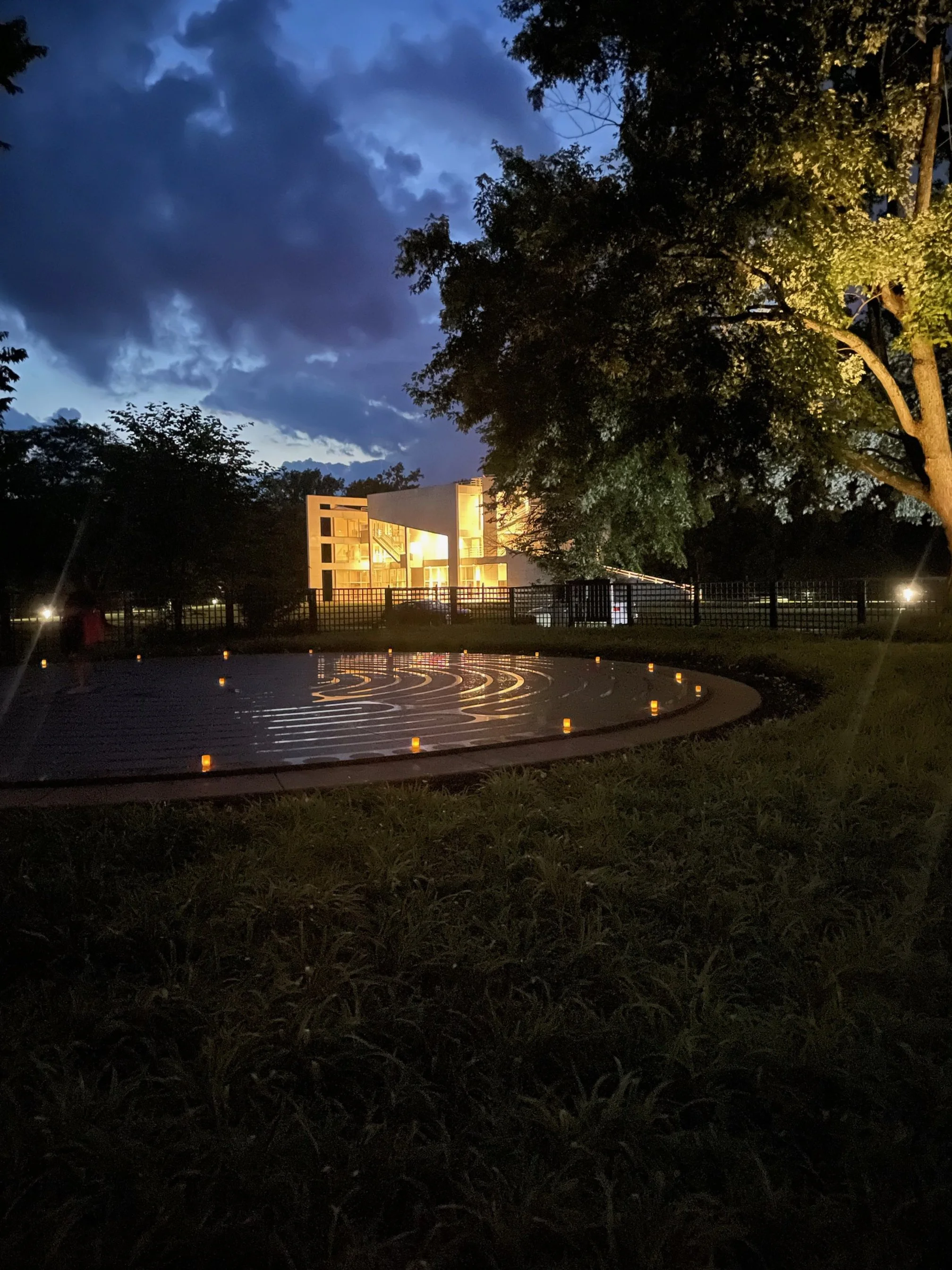
Photo by Grace Pardun
Getting divorced after 18 years of marriage has catapulted me into a chaotic disorientation, deconstruction, and reconstruction of how I fit in the world. When I was married, we were a package deal. We’d go out to eat together. We’d go on vacations together. We’d make decisions together, experience new things together. But now it’s just me, and I am trying to gain the confidence to do things on my own. I travel alone. I go out to eat alone.
And that Saturday night in New Harmony, Indiana, I was alone. I was finishing up my bacon wrapped filet mignon at a fancy, romantic restaurant connected to my hotel, sitting at a table that was set for two before they removed the unnecessary dishes. My attentive waiter asked what my plans were for the evening. I had no idea. I didn’t know what I wanted to do. I had come to New Harmony to take a painting class and to recharge. The night was young, I had no responsibilities. No one to check in with. No one else’s needs to accommodate. I could do literally anything I wanted to do but the problem was that I didn’t know what I wanted to do. I wanted to recharge but as a chronic workaholic, I don’t know how to do such things. My life up until this point has been oriented to others. Bless their heart, they had no idea they asked me such an existentially distressing question.
“Walking meditation is to really enjoy the walking; walking not in order to arrive, but just to walk. The purpose is to be in the present moment and aware of our breathing and our walking, to enjoy each step.”
As I left the restaurant, I noticed a sheet of paper on a kiosk outside advertising a community candle lit labyrinth walk scheduled for sunset. I looked up at the sky above me and saw that it was in fact nearing that time. So instead of heading back to my room, I turned and walked towards the labyrinth.
The community in Harmonie, Indiana was founded by a German zealot named Johann Rapp in 1814. The Harmonists were a separatist group of Lutherans who dreamed of living out their faith in a harmonious utopia. When they came over from Germany, they first settled in Pennsylvania, and after selling their community to Mennonites, they moved down what is now New Harmony, Indiana. The labyrinth was a key symbol and practice in their faith. They built one in each of their locations. Their community changed hands after about a decade. And then after a few years, that community, the Owenites, also moved on. But the history and legacy of New Harmony was resurrected by Jane Baffler Owen in the mid 20th century.
It was Jane Owen who had the vision, and frankly the funding, for what New Harmony is today. She wanted to capture the vision of the Harmonists and the Owenites and adapt it for generations to come. So she incorporated intentional art and architecture into the historical design of the town.
One of Jane’s projects was to design and create a second labyrinth in New Harmony, the Cathedral Labyrinth, on North Street. Made from granite with the edge of the pathway etched, the labyrinth is intended to be walked barefoot, shoes left at the entrance, the warmth of the sun felt under toes, the coolness of the night chilling soles after the sun goes down.
Growing up, going to church was a family thing. We did it together. There was programming for us–kids church, adult Sunday school for my mom and dad. We sat together in the pews. We got to know other families in the church, my brother and I making friends with kids our age, our parents making friends with the other parents. But now that I have no family, it’s just me, and as a chaplain I’m not usually leading worship. I don’t know where I belong. I remember one of my first Sundays at the church where I attend regularly and Cathy turned around in the pew in front of me to invite me to dinner. “It will be couples, but you’re more than welcome to come, too,” when I told her I don’t have a plus one. Her call with the details about dinner never came.
I walked through the gateway to the labyrinth and saw that people were beginning to gather. Some were lighting candles and placing them around the edges. Not knowing what to do with myself, I offered to help. People trickled in and soon we had a group of about 15 to 20 people all chatting with each other.
Mary opened up a cardboard box and inside was a complete set of chimes- at least two octaves worth. She handed them out. I tried out a few tones, not sure which one I wanted to be for the evening. I wasn’t even sure what we were supposed to do with them. I’ve played bells in church, so I knew what they were, but I didn’t know what they had to do with a community sunset labyrinth walk.
Finally, we all gathered at the mouth of the labyrinth. We took a few collective deep breaths and then began our journey together. Periodically, someone would play their chime and someone else would respond. While we walked, we chimed, we adjusted our speed for each other, and we listened.
Then without discussion, we simply fell silent. The chimes stopped. Feet no longer shuffled. And we stood there in silence.
Thích Nhất Hạnh once said, “Walking meditation is to really enjoy the walking; walking not in order to arrive, but just to walk. The purpose is to be in the present moment and aware of our breathing and our walking, to enjoy each step.” The invitation to simply walk and not to decide, to stay in the moment and not think about what is ahead, to reduce the complexity of being a grieving human to a being who is walking, was exactly what I needed.
Labyrinths began appearing across cultures over 5000 years ago. They look like mazes because their paths wind and turn, but where mazes have dead ends, the path of the labyrinth leads to the center. Unlike a maze, it is impossible to get lost in a labyrinth. Christians began using them in their practice around 1000 CE. Medieval Christians likened walking labyrinths to Jesus’ journey to Jerusalem. One of the most notable labyrinths is the one at the Cathedral in Chartres, France. This is the one that our labyrinth in New Harmony is modeled after.
As people reached the center, we waited for everyone else to gather there. And as we waited, we played our chimes, standing in a circle. I listened to the other tones and tried to remember their pitches as well as my own, so that I could try to make some kind of song together with them all. Then without discussion, we simply fell silent. The chimes stopped. Feet no longer shuffled. And we stood there in silence. The sun had set by then. We could see each other’s faces in the flickering light of the candles and the soft moon. Lightning bugs blinked all around us, floating up and down like magical fairies of the night. An owl in the trees above us hooted over the cacophony of frogs. We stood there together, marveling at the enchanted evening and the miracle that this moment was. We were still. We listened to the night around us. We listened to our hearts. We waited. And then Charlie spoke.
“I am so grateful. I am grateful for each one of you. I am grateful for this place. I am grateful for this night. I am so grateful.” We each murmured our own response of gratitude. Again there was silence, except for the frogs and the owl. After a little while, we retraced our steps back to the beginning of the labyrinth. Chimes rang out again and we made music as we walked. Our tones mixing with the frogs and the owls and the shuffling of our feet.
Among faith communities, I’m often not sure how I’ll fit, because I’m no longer part of a couple, I have no children, I’m not of retirement age, I’m a chaplain instead of a pastor. As someone who is lonely and lost and is in the process of reconstructing their life, this experience of walking the labyrinth with a bunch of people I’ve never met was the most welcoming church experience I’ve had in decades. We gathered together intentionally. We walked a journey together. We made music together.
And for that moment, I wasn’t divorced or lonely or overwhelmed or lost. I was connected to something so much greater than myself, the Presence who drew themself closer to me with each step, each breath, each moment, each chime.