More Than Virgin, More Than Mother: Mary Beyond the Binary
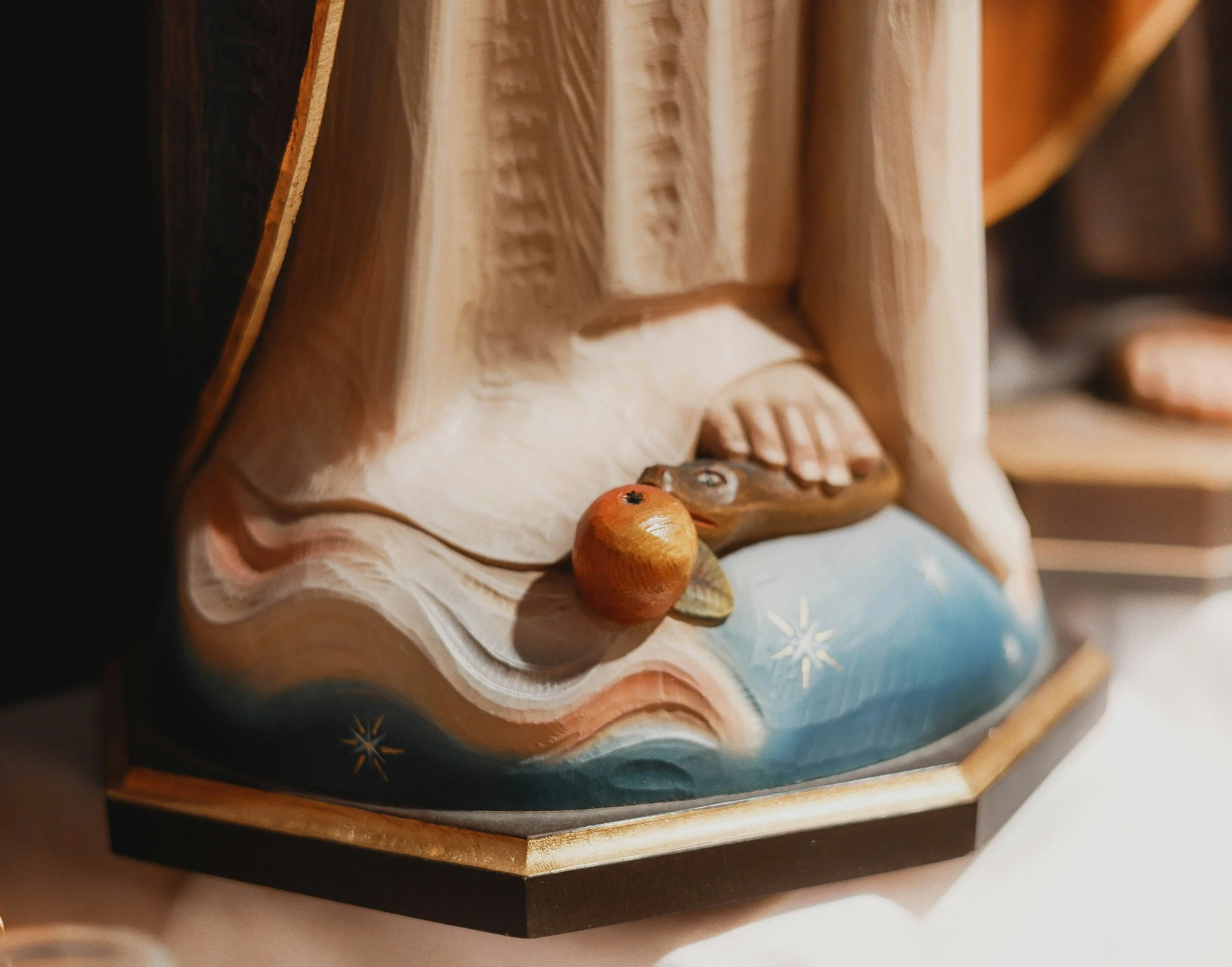
Photo by Matea Gregg on Unsplash
Advent is a season that invites us to slow down and look again—to notice where God is drawing near in places we might overlook. As we wait for Christ, many of us return to Mary, the one who first carried this holy disruption in her own body. But the Mary we inherit through tradition and the Mary who stands before us in Scripture are often not the same.
Mary has long felt complicated to me—not because of her own story, but because of the one we’ve crafted around her. She’s so often portrayed as a pristine symbol, the spotless virgin or the silent, obedient mother, instead of a living, breathing woman we can actually encounter.
That’s the trouble with many of our holy images: they struggle to hold the weight of real life. Some feel too sanitized to reflect the women who raised us, too idealized to honor their complexity. And when these images aren’t polished, when they stray from the ideal, they often become cautionary, telling us who we shouldn’t be. Mary’s image, in particular, is shaped by empire’s harsh binary: women as either virgins or temptresses, leaving little room for the fullness of our stories.
As a child, I was immersed in stories of Mary. Sitting beside my abuela watching Telemundo, we’d see report after report of Mary appearing in everyday places: a water stain on a wall, a burned image on a piece of toast, or static on the television. I was equal parts amazed and afraid that she might show up to me next. I didn’t always understand these stories, but I knew they meant something. They whispered that God was close to my people, speaking through the ordinary and the surprising. That truth comforted me more than I realized at the time.
This is not the Mary of our tidy nativity sets.
Years later, as my faith shifted and re-formed, I began to question not only those Telemundo headlines but also the deeper truth behind them. I recognized how those appearances embodied how God would choose to speak to a marginalized community through Jesus’s own marginalized mother. I see now how essential these symbols were for a people who often felt displaced or forgotten. They may not hold the same weight for the privileged, but for the women who raised me, they were lifelines—quiet reminders that God saw them.
I began to think differently about those women—the ones who prayed fiercely, survived quietly, and carried their own contradictions. Women who created sacred spaces in their kitchens and living rooms because the church didn’t always know how to welcome them. Women who loved God with their whole being, even as they navigated the patriarchal and colonial narratives they hoped would save them.
This is where Mary becomes both tender and difficult for me.
The Mary given to us by empire is an impossible ideal—pure, modest, untainted by desire or struggle. A woman whose holiness is defined by her distance from the mess of human life. But the Mary of Scripture? She is far more complex, and far more like the women I know.
Mary lived under empire’s shadow. She was a poor, brown, Jewish girl in an occupied land. Her life was shaped by social expectations she never asked for. And yet God entrusted her with the most intimate work imaginable: to carry, birth, and raise the Christ.
Her Magnificat makes this clear. It is not a gentle lullaby but a protest song—a fierce, bold, unapologetic declaration that God is overturning unjust systems and lifting up the lowly. Mary sings as a young woman whose pregnancy stands outside the boundaries of patriarchal norms. In Luke’s telling, Joseph isn’t even consulted. The decision to carry the child who will redeem the world is shared only between Mary and God. This powerful detail speaks to a sacred reclaiming of Mary’s own body in one of the most personal and intimate ways imaginable. God meets her directly, calls her directly, and honors her agency in a world that often refused to see it.
This is not the Mary of our tidy nativity sets.
This is Mary the theologian.
Mary the prophet.
Mary the liberator.
When she sings about God scattering the proud and filling the hungry, she is not speaking metaphorically. She is naming the world she knows—where the poor are shamed, where women are controlled, where holiness is defined by those who hold power.
And yet, through her body, God enters a different kind of story.
Mary becomes both the subject and object of liberation—lifted up and lifting others up. She becomes the first sanctuary of Christ, the first preacher of the gospel, the first witness to the revolutionary reversal God is bringing about.
For many of us shaped by immigrant families or marginalized communities, this Mary feels familiar. She looks like our abuelas—complicated, courageous, caught between survival and hope. Women who resist in their own quiet ways while also carrying the weight of harmful narratives they inherited. Women whose faith is not perfect, but persistent.
This is the tension I hold as Advent comes around again: Mary is both the symbol of patriarchy’s expectations and the symbol of God’s liberation. She is both what empire tried to make her and who God called her to be. And in that space—in the “in-between”—so many of our abuelitas live. So many of us live.
The story of Mary is not about idealized womanhood. It is about the God who enters into the real conditions of people’s lives—messy, embodied, complex—and calls forth liberation from the very places empire overlooks.
From Mary’s womb comes not only Jesus but a whole lineage of holy resistance. A theology that is birthed in kitchens, whispered in prayers, carried in bodies that refuse to disappear. A theology of abuelitas comes alive through Mary, our ancestor and co-madre— and it continues through the daughters and granddaughters who carry her song forward today.
As we move through Advent, may we listen for Mary’s voice—not the sanitized version, but the courageous one. May her song help us bless the women who shaped us, in all their strength and struggle. And may we, too, carry Christ into the world the way she did: not perfectly, but boldly, honestly, and with our whole embodied selves. Because God still chooses to be born in unlikely places, and sometimes those places look a lot like us.