Divesting From Empire: Exploring Matthew’s Call
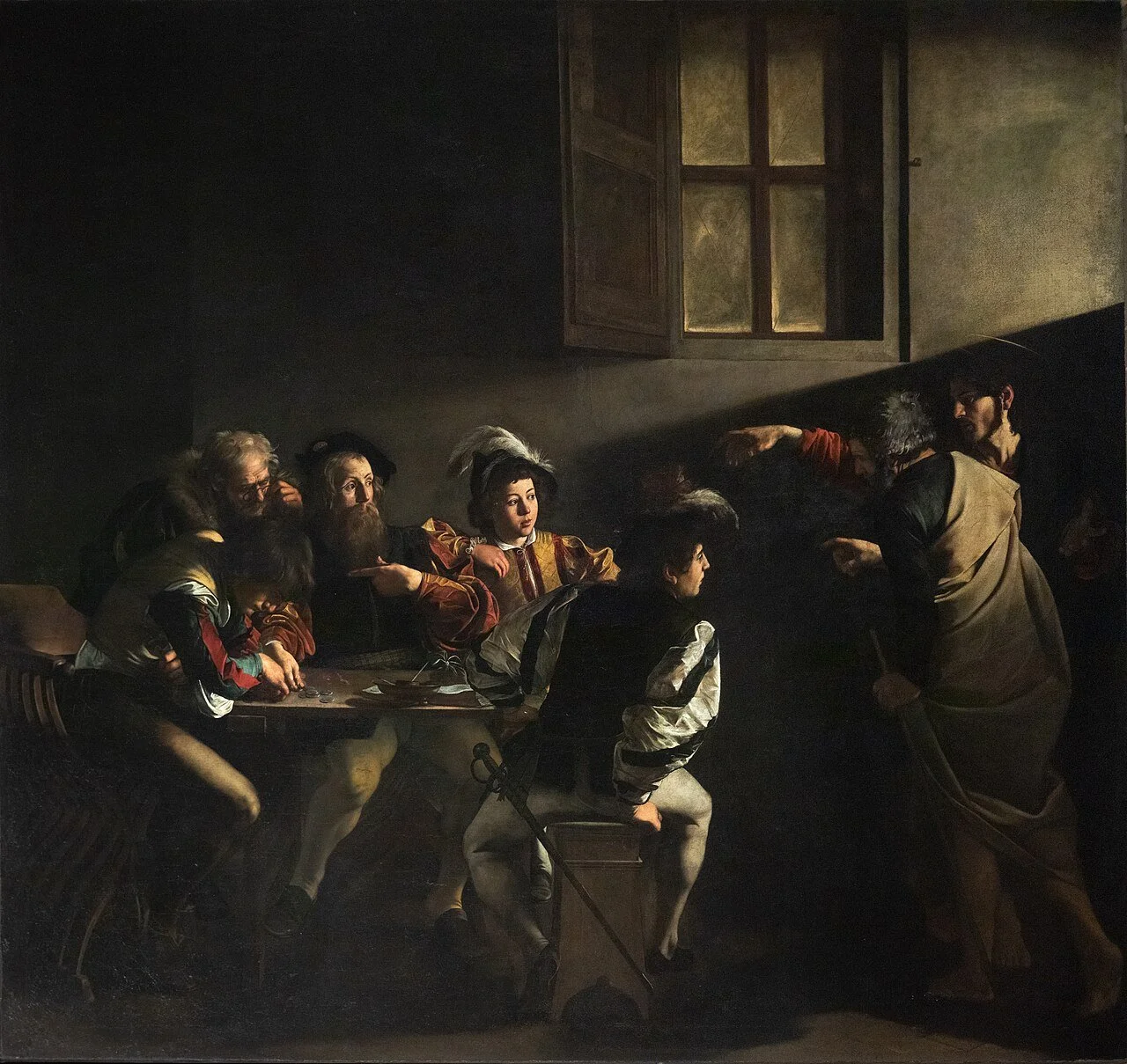
The Calling of St. Matthew, Caravaggio
Several years ago, I had the chance to see The Calling of St. Matthew in person. Almost by chance, during a day of wandering around Rome, I happened to notice a small sign outside San Luigi dei Francesi church indicating that there were Caravaggios inside. When I stepped in, I was surprised to encounter one of my favorite religious paintings: The Calling of St. Matthew, a work that captures how Christ calls us out of our enmeshment in exploitatively profitable systems.
As might be expected from Caravaggio, whose greatest religious works were painted while he was a fugitive from a murder charge, the painting is a study in darkness, light, and drama. The scene appears to be a tax-collector’s office (often described as a counting house). A group of finely dressed men are gathered distractedly around a table, save for one young man – whom I have always assumed to be Matthew – who is bent over, absorbed in counting up the day’s coinage. (Part of what makes this painting compelling is that it is unclear who among the men seated at the counting table is Matthew.) For me, a great deal of the painting’s power lies in that young man’s posture: it is an all-too-familiar one of intense concentration, the same posture I take when checking accounts, reviewing a budget, seeing my credit score, or worrying over a spreadsheet of expenditures.
Absorbed as he is at the task at hand, Matthew does not yet realize who has just entered the room. On the right hand side of the painting, Jesus and Peter have just walked in, dressed far more plainly than Matthew and his well-turned-out companions. Jesus is pointing toward the man who does not yet know that his life is about to be transformed. It is we, the viewers, who know what the young Matthew does not: that he will rise and follow, leaving those coins on the table, and that his life will never be the same.
Lately, whenever I have had the chance to lead workshops with mainline clergy about money, I begin by looking at this painting together. Together we recall that Matthew is described in the Gospels as a tax collector – and more specifically, as a toll collector or customs agent – whose work therefore tied him to the Roman empire’s tax system (Mark 2:14; Matthew 9:9). This helps us better understand some of the details of the painting: the coins, the rich clothing. All signs, in Caravaggio’s rendering, of profit drawn from an exploitative system. There is, in other words, a shadow around the money on that table, a complicity away from which Matthew is called. In this sense, the painting captures something frequently overlooked in discussions of faithful discipleship: when Christ beckons us to follow, this requires a radically transformed relationship with our own coins on the table. And I believe this to be true for both individuals and churches alike.
Already on the margins of society, these “rootless men” were further isolated by their despised profession. Few appear to have grown rich in the process, as the largest profits flowed upward. Even so, men like Matthew, who would have worked under intense pressure, served as the face and frontline of this exploitative system.
This liturgical year, as mainline denominations read Matthew’s Gospel, it is helpful to recall the historical background that sheds light on the stakes of his calling.
The Gospels of Mark and Matthew present Matthew (also called Levi) as a telōnēs, a tax or toll collector – a role widely despised in Jewish society at the time. Roman taxation in Judea operated through multiple layers of contracting: local agents collected tolls, customs, and other indirect taxes on behalf of higher-level contractors who, in turn, answered to Roman authorities. Matthew is not described as a “chief tax collector” like Zacchaeus (Luke 19:2), but rather as a lower-level collector stationed at a booth or customs point.
As a toll or customs collector, Matthew would have collected levies from tradesmen, craftsmen, and even sex workers on goods entering, leaving, or being transported across a district, as well as from those passing through crossover points such as bridges, gates, or landings. Such agents profited by charging above the assessed tolls, which helps explain their reputation for greed and extortion.
At the same time, they were likely not wealthy and were not members of the elite. In Social-Science Commentary on the Synoptic Gospels, Bruce Malina and Richard Rohrbaugh note: “The tax collectors familiar in the Synoptic tradition were for the most part employees of the chief tax collector and were often rootless persons unable to find other work. Evidence from the late Imperial period suggests that cheating or extortion on their part would be less likely to benefit them than the chief tax collector for whom they worked.” Already on the margins of society, these “rootless men” were further isolated by their despised profession. Few appear to have grown rich in the process, as the largest profits flowed upward. Even so, men like Matthew, who would have worked under intense pressure, served as the face and frontline of this exploitative system.
Given this, Caravaggio’s decision to portray Matthew in the fine clothing of the artist’s own day is imaginative. Historically, he may have been dressed more roughly – much closer to how Peter and Jesus are portrayed than to the fashionable company at the table. Yet the contrast sharpens the different paths taken in life: in Caravaggio’s vision, Matthew’s work has made him prosperous. He and his companions look great. But soon this young, wealthy man will be summoned by God to divest—literally and figuratively—and pursue a very different way of life.
Indeed, when I saw the painting in person, on that hot summer day in Rome, I was struck not only by the painting itself but by how it was positioned within the church. As I recall, the painting was located adjacent to another Caravaggio, The Martyrdom of St. Matthew. In that chapel, there was a beginning and an end, an embodiment of Matthew’s transformation from minor tax collector to apostle of Christ, and a powerful meditation on what Bonhoeffer called “the cost of discipleship.”
I’ve done this reflection exercise several times now, and one clergy colleague’s response has stayed with me. He noted that while Matthew’s call is portrayed by Caravaggio as a once-and-for-all moment, for most of us it is a continuing summons to reflect on our enmeshment in exploitative economic systems and on how we are called beyond them. I think he’s exactly right. I fully recognize that there is no such thing as moral purity in our economic system. Yet in our calling, there is a summons to self-examination. We must come more fully to terms with how deeply enmeshed we-–as individuals and as churches—are in profoundly exploitative, economic systems.
In his 1619 Project essay, “American Capitalism Is Brutal. You Can Trace That to the Plantation,” Matthew Desmond traces connections between the racial wealth gap, “the union-busting capitalism of poverty wages, gig jobs, and normalized insecurity,” and even modern management and accounting methods, to the not-so-distant realities of the American slave plantation. It is an eye-opening essay that helps explain why America’s particular form of capitalism—compared with that of other nations—is so racially polarized, so unequal, and so shockingly brutal. For those of us in largely white, well-resourced mainline denominations, there is work to do in confronting how we have historically been—and remain—the beneficiaries of this system.
In other words, like Matthew, we are called to recognize how the coins on our tables are products of what Desmond calls America’s uniquely brutal form of “low-road capitalism”; and, in an ongoing process, I believe we are summoned to profound forms of divestment—both literal and figurative—so that we may more fully invest our lives and talents in pursuit of a different way.
There is one final detail in the painting I wish to note. Some art historians have observed that the casual gesture with which Jesus points toward the young Matthew intentionally echoes Michelangelo’s depiction of God’s hand in The Creation of Adam. Could it be so? If this is the case, it suggests Caravaggio’s hope for a new creation: the re-creation of a person in Christ, and perhaps even a renewed relationship to money, one that fully honors the God-given dignity of the human person.