The Parable Wall Street Loves
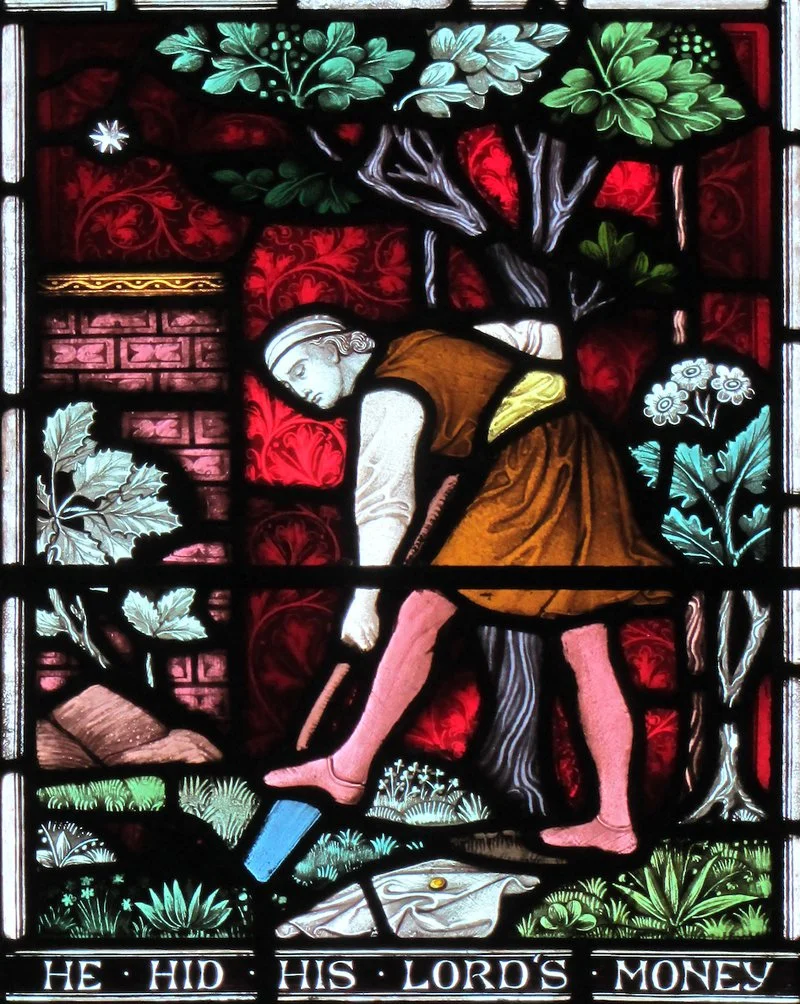
He Hid His Lord's Money, from Art in the Christian Tradition, a project of the Vanderbilt Divinity Library, Nashville, TN. https://diglib.library.vanderbilt.edu/act-imagelink.pl?RC=57778 [retrieved February 19, 2026]. Original source: https://www.flickr.com/photos/hobler/14073476777 - Roman Hobler.
Several months ago, I met a clergy colleague for coffee, and as so often happens in church life, the topic of congregational finances came up. My colleague discussed the need for better stewardship campaigns, the exigencies of budgets, and regarding money, the general need to make a lot more of it. At one point, while referring to getting better returns on a parish’s endowment portfolio, he briefly referenced: “You know, like in the parable of the talents” (Matthew 25:14–30). While a passing comment, it stood out to me because 1) it was the only reference to Scripture in our hour-long conversation and 2) it assumed I agreed with his wealth-forward interpretation.
As brief as it was, that brief reference to the Parable of the Talents has stayed with me. In many settings, this parable has become a go-to text in discussions of congregational finances, used to justify everything from maximizing investment returns to, I would argue, undergirding a generally pro-wealth posture among mainline churches today. On a surface level, this is understandable. The Parable of the Talents is perhaps the one place in the Gospels where Jesus speaks favorably about bankers and investment: “Then you ought to have invested my money with the bankers, and on my return I would have received what was my own with interest” (Matthew 25:27). And because it is the servant who fails to invest the talents who is condemned, the text offers a biblical rationale for capital investment and maximizing returns.
Indeed, this interpretation is so common that Trinity Wall Street — the wealthiest church in the world, with a real estate and investment portfolio valued at over six billion dollars — has implicitly framed the Parable of the Talents as its theology of money. In 2022, Trinity made the parable the subject of a new stained-glass window on its main entrance façade. Designed to be visible from the street, it was selected to communicate how the church understands its role and responsibility in growing and using its wealth. In an online forum, the rector, the Rev. Phillip Jackson, explained that while some in the congregation had urged him to send a challenging message to Wall Street, he chose the Parable of the Talents to express Trinity’s responsible stewardship of its resources. Standing before the window last year, I could not help but wonder how differently things might have been had Trinity chosen the parable of Lazarus at the Gate, for instance, and I noted how comfortably the window sits just sixty paces from the New York Stock Exchange.
The Parable of the Talents has, at least functionally, come to be interpreted through the lens of congregational finance and wealth stewardship. In many places, it is emphasized as a consoling text that softens and contextualizes other, more challenging things Jesus said about wealth: not being able to serve both God and mammon (Matthew 6:24; Luke 16:13), his instruction to the rich young man to sell his possessions and give to the poor (Matthew 19:16–24; Mark 10:17–25; Luke 18:18–25), his critique of inequality in the parable of Lazarus at the gate (Luke 16:19–31), his ridiculing of the rich man who stored all his goods in barns (Luke 12:16–21), and, particularly challenging for the New York Stock Exchange, his command to lend without expecting interest (Luke 6:34–35). In contrast to these and many other examples, the Parable of the Talents is that rare moment in the Gospel where Jesus appears to praise wealth accumulation. And so the question remains: is this what the Parable of the Talents really means?
As many readers will already know, the Parable of the Talents appears within Jesus’ great discourse on the final things, the last of his five major teaching discourses in Matthew. This discourse is delivered on the Mount of Olives just before the narrative turns toward the Passion. Significantly, the Parable of the Talents is sandwiched between two other eschatological scenes: immediately before it, the Parable of the Bridesmaids (25:1–13), with its stark warning to remain watchful because the bridegroom comes at an hour no one knows; and immediately after it, Jesus’ vision of the final judgment (25:31–46), in which the Son of Man separates the sheep from the goats and humanity is called to account (pun very much intended) for its treatment of “the least of these”: the hungry, the thirsty, the stranger, the naked, the sick, and the imprisoned.1
When read together, a different notion of what Jesus meant begins to emerge. The Talents asks what disciples do with what has been entrusted to them during the master’s absence, and Matthew’s portrayal of the final accounting centers on whether we have recognized and served the Son of Man when he has come to us as the hungry and thirsty, the stranger, the naked, the sick, and the imprisoned. In this reading, the Parable of the Talents is not about wealth accumulation, but on whether we have used what we have been given to serve “least of these.”
Since I have already mentioned Trinity Wall Street’s stained-glass window, it is only fair to note that, in that same rector’s forum, Rev. Phillip Jackson described how it was the artist, Tom Denny, who helped recontextualize the parable within Jesus’ discourse on the last things. As a result, the window also includes references to the final judgment, making it not only about Trinity’s prudent investment and growth of its wealth but also about its right use. Jackson observed that this corresponds to his own imagination of the final judgment, in which he expects to be asked by God how he used Trinity’s vast resources to foster the kind of philanthropy that helps, heals, and serves the world. And truly, since 2019 especially, Trinity has done great things with its vast resources, including $502 million in charitable giving. Nevertheless, the ease with which Trinity’s window sits on Wall Street calls to mind former Ford Foundation president Darren Walker’s critique of philanthropy: while it can accomplish a great deal of good, it leaves the structural causes of inequality largely unchallenged.2
Thus far, we’ve explored two common interpretations. At the crassest level, the Parable of the Talents is read as a proof text for Jesus’ approval of prudent investment and wealth accumulation. At a more nuanced level, it affirms wealth accumulation so long as it is put to proper use, serving as a rationale for Christian philanthropy. Critically, both interpretations hinge on the notion that the “talents” of the parable are to be understood straightforwardly as money. But what if that assumption is mistaken? What if the great treasure we have been given does not refer to money at all?
In November 2023, the now-late Pope Francis preached on the Parable of the Talents for the World Day of the Poor. Not surprisingly, he offered a very different take on this parable. Comparing Jesus to the master who leaves on a journey, Francis noted that Jesus left behind “a genuine capital”: “He left us himself in the Eucharist. He left us his words of life, he gave us his holy Mother to be our Mother, and he distributed the gifts of the Holy Spirit so that we might continue his work on earth.” In his reading, the first two “investors” represent the figures who are willing to take risks with this treasure - not risks in the market, but rather in ministry: “And the question we must ask is: ‘Do I take a risk in my life? Do I take a risk through the power of my faith? As a Christian, do I know how to take a risk or do I close myself off out of fear or cowardice?’” He then urged the Christians gathered to take risks in getting to know the poor and to risk seeking the poor out, while noting that poverty is frequently discreet, hiding in plain sight. And while he nodded to the value of charity, his main emphasis was on how the “genuine capital” of our lives empowers us to live in closer friendship and solidarity with the marginalized. Pope Francis concluded by praying that “each of us, according to the gift we received and the mission entrusted to us, may strive ‘to make charity bear fruit’ and draw near to some poor person.”
Why does this matter? Consciously or unconsciously, the Parable of the Talents comes up regularly as the practical rationale for all sorts of decisions affecting congregational life. For example, in many parts of the mainline Church, dioceses and other adjudicatory bodies are addressing deficit budgets by closing poor churches – in my experience, often Black and Brown congregations – and selling the properties. If one reads the Parable of the Talents through a purely financial lens, such closures are nothing more than good financial stewardship. The second, more philanthropic reading raises questions about how the proceeds of such sales will ultimately be used, perhaps pointing toward the creation of grants with Matthew 25’s “least of these” in mind. But if the parable is read as a story about how the “genuine capital” Jesus leaves behind (“his words of life…the Eucharist”) empowers us to risk entering into solidarity and friendship with the poor, the hungry, the imprisoned, the thirsty, and the marginalized, then we are coming from a different place altogether. It may lead church leaders to pause, value Christian communities made up of the economically marginalized in a new way, and begin to dream of new possibilities.
1 As a gay man, I always find it striking that the criteria of judgment in Matt 25:31–46 make no reference to sexual conduct or gender or sexual identity. Hunger, thirst, estrangement, nakedness, sickness, and imprisonment are all categories of vulnerability and exclusion, and judgment would seem to hinge on how we have treated people experiencing these things. Ironically, LGBTQ+ persons, and especially youth, are disproportionately represented among those experiencing homelessness and economic precarity, often as a result of family rejection. To that extent, many fall squarely within the groups Jesus names.
2 “The old playbook — giving back through philanthropy as a way of ameliorating the effects of inequality — cannot heal what ails our nation. It cannot address the root causes of this inequality — what the Rev. Dr. Martin Luther King Jr. called “the circumstances of economic injustice which make philanthropy necessary.” See Walker, Darren. “The Way We Fund Social Change Is Changing.” The New York Times, June 25, 2020. https://www.nytimes.com/2020/06/25/opinion/sunday/black-lives-matter-corporations.html