
Renouncing Evil, Remix Style: Themes of Redemption in KPop Demon Hunters
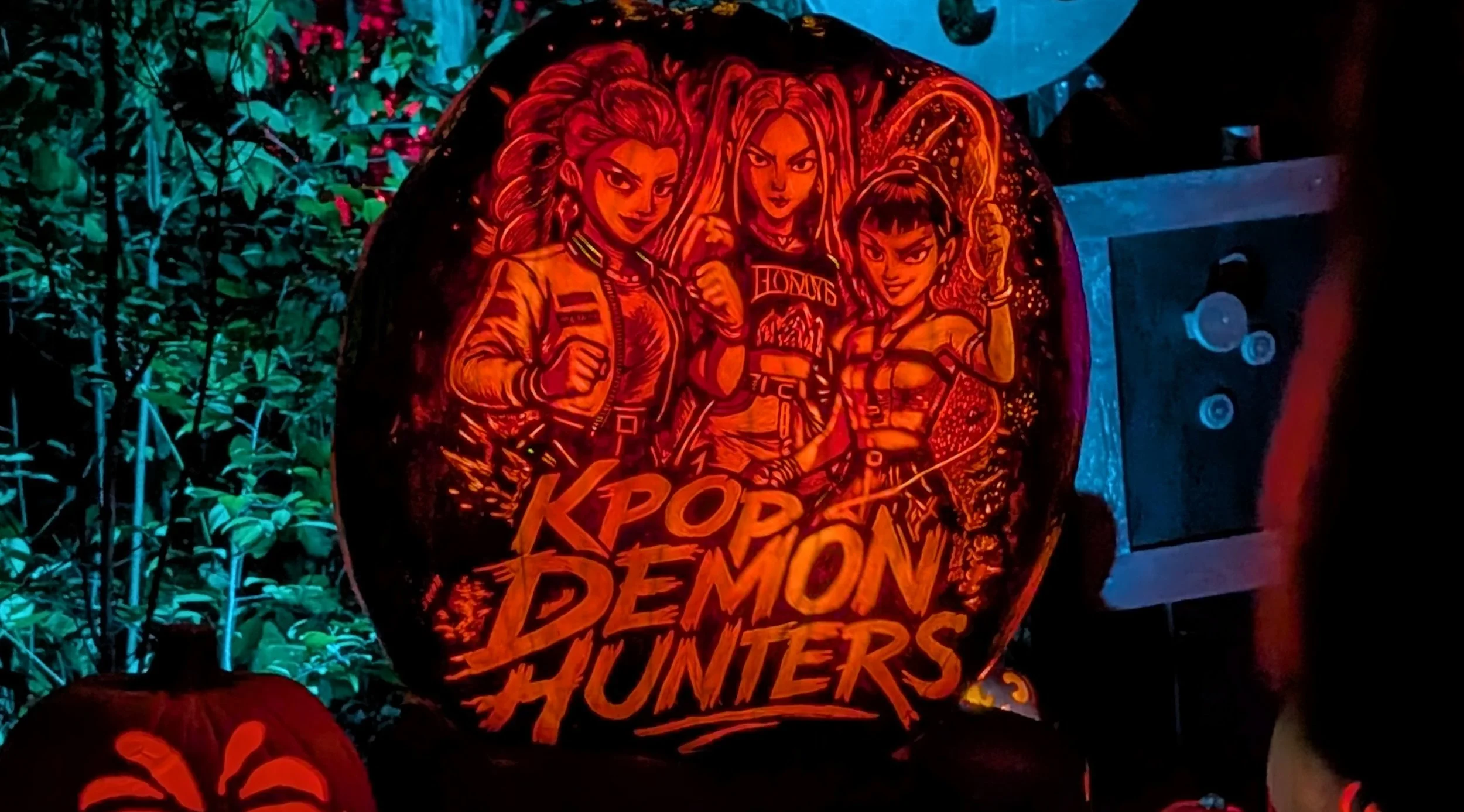
Photo taken at the 2025 Minnesota Zoo Jack-O-Lantern Spectacular
Any pastor, preacher, youth minister, or faithful parent has worried about what the “kids these days” are watching. One of the latest concerns comes with a neon glow and a potentially surprising title: KPop Demon Hunters. Before we assume it’s a gateway to devil worship, let this pastor and mom note a few shared themes between this musical hit and our own theology.
If you don’t have a child in your life who has memorized the entire soundtrack, let me fill you in: KPop Demon Hunters is a 2025 animated film with a catchy soundtrack, and the main characters are a KPop (Korean pop music) trio named Rumi, Mira, and Zoey. To the world, they are a girl band called Huntr/x (pronounced “huntrix”), but in reality, they are demon hunters, and their singing keeps a barrier between our world and the world of demons intact. Whenever a demon does break through the barrier, they fight it to the death.
But as a pastor, I’d gladly host a youth group KPDH movie night to highlight our own theological concepts of sin, brokenness, redemption, and wholeness.
The king of the demons decides to send a few demons up in the form of a boy band to rival Huntr/x, in hopes of sowing dissent between the three women. If the pop trio can no longer strengthen the barrier between the two worlds, the demons will be able to break through and take over the human world.
We discover that Rumi, lead singer of Huntr/x, is harboring a secret: she is half-demon. When Jinu, the lead singer of the demonic rival boy band, discovers Rumi’s true nature, they begin to meet in secret. A love story unfolds, and Rumi and Jinu both move towards self-acceptance as they both wrestle with their inner demons, so to speak.
The depiction of those inner demons makes this a deeper movie than meets the eye. As you might imagine, anything with “demon” in the title is an easy target for “satanic panic.” You may remember the cultural backlash against Dungeons and Dragons in the 1980s, based on the idea that children exposed to evil creatures in games or media will be influenced by them and become Satan worshipers. But as a pastor, I’d gladly host a youth group KPDH movie night to highlight our own theological concepts of sin, brokenness, redemption, and wholeness.
As part of our baptismal liturgy, we ask the candidate for baptism or their parents and sponsors to renounce evil. When I meet with parents who want their baby baptized, I find myself needing to give this part a lot of context, because the language is strong. We ask them to “renounce the devil and all forces that defy God,” then to “renounce the powers of this world that rebel against God,” and finally to “renounce the ways of sin that draw us from God.”
It might sound intense to speak these words on behalf of a tiny baby, at least in traditions that don’t tend to personify or give a lot of airtime to the devil. But what better explanation of sin and all our human brokenness? The forces that defy God and all of the abundant life that God intends for everyone. The powers of the world that make that happen. And everything that draws each of us and all of us away from that collective abundant life.
In KPop Demon Hunters, demons were once humans who did something unforgivable in life. Their punishment is to have a voice in their head reminding them how deeply and essentially bad they are. In the narrative arc of Jinu, the demon-turned-boy-band-singer, he comes to find that he is not defined by his worst acts. When he lets go of the voice of perpetual shame, he is free and can see things with clarity. In other words, he renounces the devil and all the forces that defy God, and experiences the healing that comes when those forces no longer rule his life.
As far as we know, KPop Demon Hunters wasn’t intended to promote a Christian message, but it does play with religious language to talk about the broader themes of good and evil. The name of the boy band, the Saja Boys, draws from the Korean folklore characters “jeoseung saja,” grim reaper figures who bring souls to the afterlife. The Saja Boys sing a song titled “Your Idol,” and the lyrics are mostly drawn from religious phrases: “pray for me,” “I can be your sanctuary,” “preaching to the choir.” The gist of the lyrics is that shame and pain feed the demons and drive people to obsession and idolatry, and the play on boy-band-idol and object-of-worship-idol is clear. And when they perform the song, they put their listeners into a trance, and everyone begins to hear the voices that tell them they are unredeemable.
A friend recently introduced me to minjung theology, a Christian liberation theology that arose in Korea in the 1970s. Military dictatorships and rapid industrialization that exploited workers and left them in poverty were the backdrop for the rise of minjungsinhak, or “the people’s theology.” Echoing contemporary liberation theologies throughout the globe, minjung theology centers justice for those in poverty, noting that Jesus came to live in solidarity with the oppressed and envisioned a world where such suffering is no more. Minjung theology also centers the Korean concept of “han,” which can be translated as “shared suffering.” Its meaning and context are profound, and I recommend the this article for those looking for an introduction to minjung theology.
Shared suffering and solidarity also shine through the plot of KPop Demon Hunters. The demon threat to the human world is not resolved through battle and violence, but through the two main characters’ mutual disclosure and eventual self-acceptance. When Rumi and Jinu share their suffering with one another, the result is their duet, titled “Free,” centered around the transformation of shame into solidarity.
So, when a little Rumi or Jinu shows up at your door for Halloween, or when your Sunday School classes won’t stop chanting “gonna be gonna be golden,” you don’t need to worry that demons are encroaching on God’s world. You can smile, knowing these kids have learned something about shared suffering and transformation and redemption. They might not appreciate it until later in life, but hey, at least for now those songs are catchy as–well, the place a demon might dwell–and maybe that’s how grace sneaks its way into the playlist.