Mary the Tower
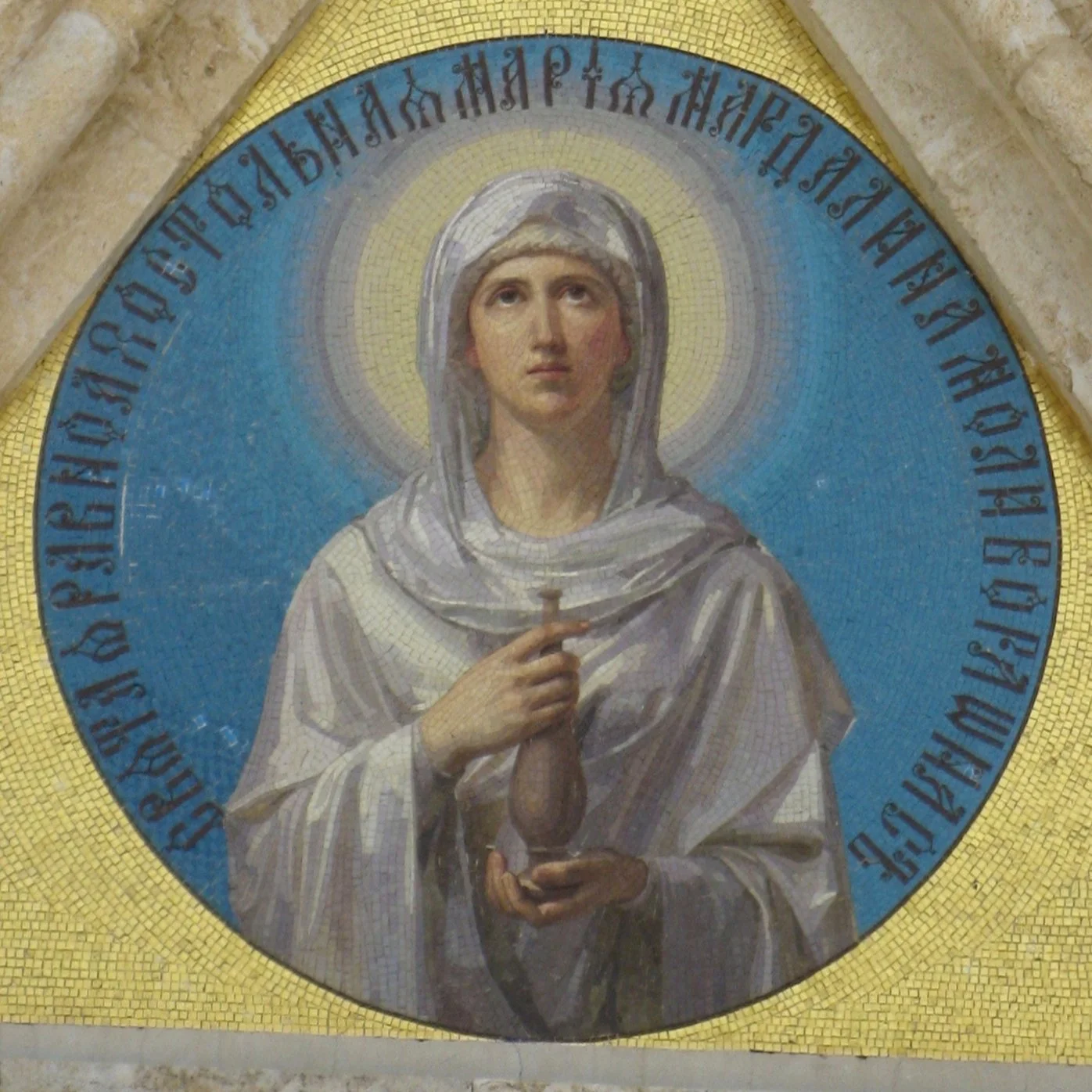
This icon is found at the entrance to the Orthodox Church of Mary Magdalene in Jerusalem. Written in Church Slavonic, the liturgical language of the Russian Orthodox Church, is the prayer: "Holy Equal-to-the-Apostles Mary Magdalene, pray to God for us." Photo taken by Deror Avi as part of the Elef Millim project trip to Mount of Olives in Jerusalem in April 2009.
I love Mary Magdalene. I have images of her all over my walls. I celebrate her feast day every July (July 22, if you’re curious) and one of my best memories from my 2023 trip to the Holy Land was when the Orthodox Church of Mary Magdalene on the Mount of Olives was finally open.
As we forge ahead to Holy Week and Easter, we rightly set our focus on Jesus. This year, I invite you to also reflect on the role of Mary Magdalene in this part of the Gospel story. Because she’s there, with lessons of her own in this season.
When you go back to the early Bible manuscripts, and even in many of the earliest translations, Mary is not called Mary Magdalene because she is from Magdala. Scholars among you will know that in Biblical Greek, “from” and “called” are very different words, so there’s not typically a lot of confusion between them. You might notice these words in relation to Simon “called” Peter, or Simon “from” Cyrene. Mary, in Greek, is not “from” Magdala. She is “called” the Magdalene.
Simon is called Peter.
Mary is called Magdal.
Simon is called the Rock.
Mary is called the Tower.
So why Magda/Magdalene?
Well first, the ending “ene” in Greek (and also in Aramaic) is just a feminizer, like how in English we feminize words by ending them with “ess” (host/hostess, actor/actress, waiter/waitress, priest/priestess, prophet/prophetess, etc).
So take off the ene, and you get the word Magda, or in Aramaic, Migdal, both which mean “tower.”
Mary, called the Tower.
Actually, Mary the Tower-ess.
Simon is called Peter.
Mary is called Magdal.
Simon is called the Rock.
Mary is called the Tower.
This is usually where I start crying. Because somewhere deep in my soul, I’ve always known Mary was more. I’ve always felt she had something else to do in the story besides be a sinful, fallen woman or even have to be attached to Jesus romantically somehow (no thank you forever Dan Brown).
She is a disciple. An important one even. Because she is given a name other than her own as a signifier of who she is, not just for Jesus but for all of us.
Peter is the rock.
Mary is the tower.
Peter is the rock. He doubts and questions and falters and stumbles and denies and runs away. And yet he is the foundation on which the Church is built.
Mary is the tower. She stands strong despite her grief and loss and broken heart. She stays when everyone else runs away. She shows up at the tomb when everyone is still hiding.
Turning the lens – even just for a minute – to Mary, we see a powerful testament of what it looks like to profess faith in the midst of everything falling apart. And I think this makes her particularly important for us in this particular time and particular place, and especially during this ramp up to Easter.
Mary is the tower because we don't only need a rock on which to build our faith. We also need a tower of faith to look to when everything falls apart. We need an example of steady and solid faith that deeply mourns and keeps showing up.
She is a tower and she is devastated.
She is both – to show us that we can be both.
And we need that right now. Every day brings news and images and stories and experiences worse than the next. More and more people we know and love are impacted. It’s compounded grief because it feels like we barely get a handle on one hard thing when the next hard thing comes barreling at us. And that’s not even including the regular life hard things.
We need Mary in our life of faith too. Our Tower to guide us, to hold us up, to offer shelter, to remind us that we too can show up even as we grieve and struggle to trust and speak our faith out loud. We need Mary the Tower to hold us steady when we cannot be steady ourselves.
We do almost impossible things during Holy Week.
We declare that Jesus is the end of death when death is all around us.
We declare that there are no godforsaken people or places when everyone is calling us both.
We declare that we believe love wins even when it feels like hate is sure getting a lot of punches in.
It’s no small thing.
None of this faith stuff is. It requires us to be – well – to be towers; standing tall, devastated and showing up anyway.
As we go through the days ahead, we too will have regular opportunities to stand as towers. Don’t forget to look to the one who did it first. Like Mary on Good Friday, we will not look away or crumble at the impossible pain and grief of people who are being terrorized by the occupying forces of a crumbling empire. And like Mary on Easter Sunday, we will keep showing up, even in moments when it seems like hope is lost, and we too will encounter resurrection.