The Bible on “No Kings!” (Part III)
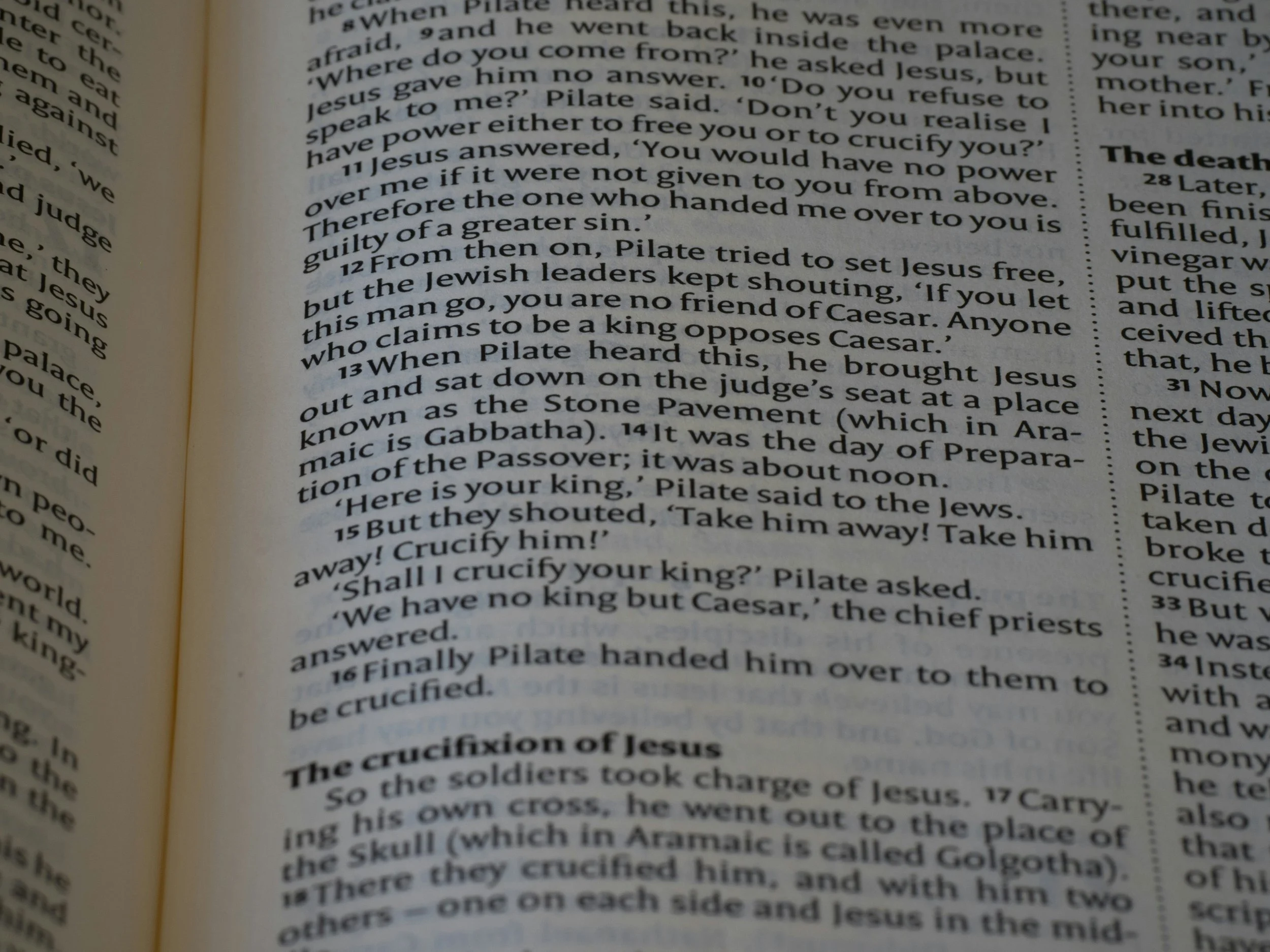
Photo by Brett Jordan on Unsplash
Over the past two weeks, as the calendar marches us towards the 250th anniversary of our nation’s founding, we’ve examined the throughline of “No Kings!” in the biblical texts (see “No Kings!”, Part I and Part II). To review, and as our script moving forward, we must remember that, in Israel, “No Kings!” was uttered:
By Samuel (and God behind him) in trying to dissuade Israel from a form of government that would, invariably, be oppressive, extractive, and acquisitive. But the people persist.
In revolt against unjust and oppressive policies begun under Solomon and renewed as a central plank in Rehoboam’s reelection campaign. That history surely goes back even further, however—in some way, all the way back to David, because it is his name, not Solomon’s or Rehoboam’s, that is invoked when the North secedes: “What share have we in David?” the northern tribes ask themselves. “None” is the answer. “No (Davidic) Kings!” The point is further underscored by Shimei who curses David, and, later, by the Chronicler: David is a warrior and a murderer, unworthy to build God’s temple—facts that stand in sharpest contrast to our saccharine descriptions of David as a man “after God’s own heart.” Not always! Not always! “No Kings!” can, and sometimes must, be uttered—even to David’s face.
And by God—through Samuel, anticipated already and earlier by Israel, freed from Egypt, and repeated by later psalmists, after the terror of exile, and by Ezekiel in his vision of a new way of life, because God already ruled over Israel such that a king was simply not necessary: not then, not now, not ever.
The prophetic sentiment “No Kings!”, however it is flexed, whenever it is uttered, knows a better way than those kinds of politics.
Later, in the New Testament, “No Kings!” was uttered by:
Jesus himself, in evading the populace that would make him monarch, even though he, as incarnate Son of God, was surely capable of good and just rule.
And by Jesus again before the powers that then were—but are no more!—namely, the petty kings and kinglets of Rome and Judea, in direct response to their politically-charged question of whether he was, in fact, a king. They already knew the answer.
In both Testaments, then, only the Lord claims full royal status, which means, of course, there can be “no kings” of the human variety because the sovereign Lord says:
I rule over them…or don’t!
My kingdom is not of this world…if it were!
Adonai rules…and none other!
And yet we mustn’t miss the fact that, despite God’s rightful rule, the Lord’s kingship, too, is somehow limited, contained and constrained, as recounted in Scripture. It begins in a real way with the exodus claim, “The LORD reigns!” and it continuesuntil the request for a stable form of human government, at which point God strongly and unambiguously counsels against such a course of action. Human rule is pursued nevertheless with what can only be seen now, in hindsight, as reckless abandon. To be sure, the divine option—God’s own reign and rule—remained a lively option, but it goes underground or appears differently thereafter. In the Psalms, for example, divine rule is liturgical if not also eschatological. Either way, it seems to stand somehow beyond or outside of time. Here and now—in the “in between” time of human governance—God’s rule is bracketed. The Lord’s kingship in the past has been rejected and the Lord’s rule in the future is not yet. In this “in between,” God’s rule feels absent, if not altogether impossible. This “in between” is nothing less than a God-shaped vacuum, into which step more and more petty, power-hungry kings and kinglets, queens and queenlets, replete with their entourages made up of foolish, vulgar advisors, all of whom want to fill that vacuum, assume God’s position, arrogate to themselves that kind of authority. All of that, of course, leads inescapably to the disillusionment of the people these power-grabbers inevitably step over and step on. And that leads “we the people,” finally, to protest and to do so with phrases like “No Kings!”
Such protest, in the Bible, was often organized and led by prophetic types: Moses and Miriam at the sea, Samuel at Ramah, Amos at Bethel, and so on and so forth. The prophets are something new: a new voice, backed by God, added into the mix of Realpolitik to counter unchecked, inhumane political power that cares little for the Lord’s rule and even less for the Lord’s Torah.
The prophetic sentiment “No Kings!”, however it is flexed, whenever it is uttered, knows a better way than those kinds of politics. In the idiom of Scripture, “No Kings!” calls for a return to primordial divine rule—Adonaimālak, the Lord rules! It also means a (re)turn to an eschatological telos: Adonai yimlōk, the Lord will rule! God will be our everlasting light, there will be no need for sun or moon, let alone stars or superstars (Isa 60:19-20). Both of these things: the divine right to rule and the purpose of divine rule, mean, of course, that no other person rules—no other person can rule—none, but our Lord. And both of those things also mean that no other entity enlightens—no other entity could possibly enlighten—none, save our God. “Come, house of Jacob, let us walk in the light of the LORD!” (Isa 2:5).
We should say “amen” to that, but let’s be honest: it’s tricky and dicey, seriously fraught in the real world, here and now, full (as it is) of other rivals to the throne. We can see this, within living memory, when the Confessing Church stood up to a German “king” who wanted to rule over a Third Empire (Reich). The Confessing Church said plainly to Hitler, and all others within earshot at that time, “No Kings!” In the Barmen Declaration of 1934, the Confessing Church asserted the following:
Jesus Christ, as he is attested for us in Holy Scripture, is the one Word of God which we have to hear and which we have to trust and obey in life and in death.
We reject the false doctrine…[that] the church could and would have to acknowledge…apart from and besides this one Word of God…other events and powers, figures and truths, as God’s revelation.1
In the New Testament, this one Word of God, Jesus Christ, avoids human rule and accepts kingship only in its most ironically opposite instantiation: not acclaim and ascension to power, but ridicule and debasement; ultimately only as a criminal, dying at the hands of a state ruled by a despot. “No Kings!” you see, because “no earthly power!” Could anything be clearer than that? Let those with ears to hear, listen! Then let them go preach the Gospel!
To be sure, the Gospel we preach also teaches that Christ’s ultimate debasement was followed, ultimately, by his resurrection and his ascension to the right hand of God such that someday every knee will bow and every tongue confess him as Lord (Phil 2:10-11). But we must be clear: that is the Son of God’s story. No merely human ruler ever did that, nor could any human ruler. Any human attempt to do so would be demonic, pseudo-Christ, anti-Christ. False prophet. False Messiah.
God’s people are called, therefore, to say, again, always, and for all time: “No Kings!” The only King we recognize went the way of the cross, not the way of the polls.
Sadly, we must confess that we, God’s people, often fail at exactly this point. We the people of God fail to say the line we should’ve learned from our script, our sacred Scripture, and so we find ourselves settling for poor substitutes that will only disappoint, disobey, and then worse. Much worse. We settle for wolves in sheep’s clothing (Matt 7:15). When offered the choice, we choose Barabbas over Jesus (Matt 27:20-21; Mark 15:11; Luke 23:18; John 18:40).
“No,” we say, “we want a king like all the nations.”
“No,” we say, “We have no king but Caesar.”
God have mercy, Christ have mercy, Spirit have mercy. Amen.
This sermon was first preached on March 3, 2026, in the chapel of George W. Truett Theological Seminary, Baylor University, Waco, Texas.
1 “The Theological Declaration of Barmen,” in Book of Confessions (Louisville: Office of the General Assembly, 1999), 246-50 (249).