The Bible on “No Kings!” (Part II)
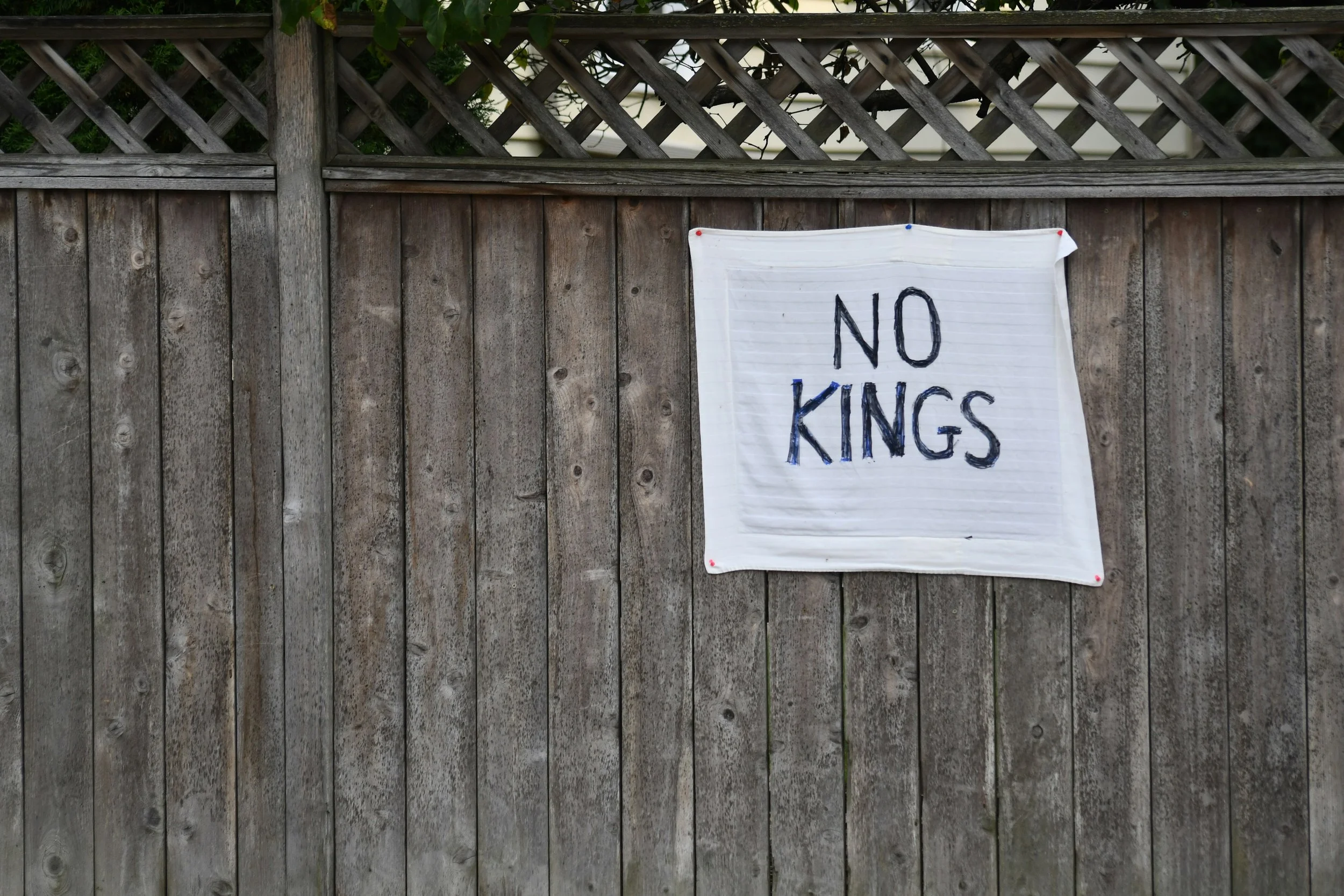
In last week’s reflection on “No Kings!”, we explored the beginnings of royal power and its abuses in Israel’s monarchy. Let us turn now to ponder a poetic text, Psalm 89. The psalmist begins this lengthy poem in praise of God’s faithfulness and steadfast love—qualities that are evident, first and foremost, in the cosmos (vv. 2, 5-14); then, among God’s chosen people (vv. 15-19); and then finally, most extensively and especially, in God’s chosen king (vv. 19-37). But this doxological beginning is just a trick, a feint, a pump fake, because the poem ends in tragedy and despair, with the total failure of God’s promises to the king (vv. 38-51). In stark contrast to the first two-thirds of the poem, the last part couldn’t be clearer that God has spurned and rejected the monarch, renounced the covenant. This, in turn, has devastating outcomes: the royal city is plundered, the enemy is victorious. Psalm 89 is ultimately about the downfall of kingship, with God’s anointed king destroyed. “No Kings!” indeed. Not anymore. Not after that.
But things are never so easy, are they? Not when other powers, other kings, are in play.
This poetic vision, likely exilic in provenance, concludes the central, third book of the Psalter (Psalms 73-89) in desolation and despair. Book 4 follows in Psalms 90 through 106, and many scholars have found a marked change here. If Book 3 ends, as it does, with the abject failure of human kingship, so obvious in Psalm 89, Book 4 does something different by affirming—or perhaps better reaffirming—the kingship of God. It is not David, nor a Davidide, nor any human ruler, but only God and God’s rule that is on offer here as the only way forward.1 Not everyone would agree with this understanding of the flow of the Psalter, but, regardless of that, the idea is hardly novel, the gist fully familiar to us by now. Recall, after all, 1 Samuel 8, pre-monarchy, at the very first inkling that the people want a king, how God said: “It’s not you they’ve rejected, Samuel—no, it’s me. They don’t want me to be their king anymore.” And if we page still further back, all the way back to the primal event, the fundamental salvific act in the Bible—the exodus from Egypt—we find the basic confession of God’s kingship on display. There, in Exodus 15, on the opposite side of the sea, Moses and Miriam lead the people in singing Adonai yimlōk: the Lord rules, reigns, is king! “The LORD will rule forever and always!” (Exod 15:18; CEB).
This same sentiment is found elsewhere, especially in the Enthronement Psalms that cluster in Book 4 of the Psalter.2 These psalms are sometimes called the “Adonai-mālak Psalms” because they repeatedly combine God’s name with the verb mālak, “to rule, reign,” drilling home again and again who is the real king, who is the true ruler, and why (see Pss 93:1; 96:10; 97:1; 99:1).3
The reality of the exile meant the end of kingship, even as the ways—that is, the (in)justice(s)—of the monarchy seems to have led inexorably to its own self-destruction (see 2 Kgs 17:7-20, esp. v. 8). Other texts join Psalm 89 to make this larger point, but we would be remiss if we did not take notice of the contribution of the prophet Ezekiel, himself an exile. The remarkable book that bears his name ends with a remarkable vision of God’s people back on its land after exile. This vision includes a capital city, rebuilt and renamed (“The LORD is There”; Ezek 48:22). It also includes the Temple, restored and cleansed. What is missing from the capital city, however, is a palace; what is missing from the polis is any mention of a king (melek).4 The only leader that is allowed in this new vision (and version!) is called “a prince” (nāśîʾ; see, e.g., 44:3; 45:7), though this term is likely less a royal figure than a kind of chieftain, with the term harkening back to pre-monarchic days (see Gen 23:6; 25:16), perhaps even to the transitional judge-prophet figure Samuel himself.5 Speaking only of a nāśîʾ, studiously avoiding melek-language, is not entirely subtle,6 but it is also not a brazen declaration of “No Kings!” But Ezekiel utters this last sentiment, too, or, rather, God does, saying to (and through) the prophet, in chapter 43:
Mortal, this is the place of my throne and the place for the soles of my feet, where I will reside among the people of Israel forever. The house of Israel shall no more defile my holy name, neither they nor their kings, by their prostitution and by sacrificing to their kings at their death. When they placed their threshold by my threshold and their doorposts beside my doorposts, with only a wall between me and them, they were defiling my holy name by their abominations that they committed; therefore I have consumed them in my anger. Now let them put away their idolatry and sacrifices to their kings far from me, and I will reside among them forever. (Ezek 43:7-9; NRSVue)
The “abominations” the kings committed are expressly included among the defilements that must and will be terminated in the new reality of God’s Temple. Not only must general acts of infidelity (figured here, as elsewhere, as acts of sexual impropriety) on the part of the people and their kings come to an end, so also must the entire cult of kingship. There is debate about v. 7— what, exactly, “sacrificing to their kings at their death” might mean7— but the passage is clear that the closeness of the royal palace to the Temple was (and is!) unacceptable to God. That situation can stand no longer. Idolatry, of gods and of powerful human beings, must be put away. The only way for God to reside among the people forever is by enacting “No Kings!” for the same interminable duration.
“No Kings!” in the New Testament
The final set of texts that should spring to mind when we hear the phrase “No Kings!” come from the New Testament, a time when Judea lived under Roman rule from various local provincials to regional governors, to, finally, “King Caesar." Into this empire, full of big government and executive orders that demanded its citizens to do this or do that, not least with regard to their places of birth (Luke 2:1-3), a baby was born in rather inauspicious circumstances. His mother, of no significant lineage, was found pregnant out of wedlock—an embarrassing situation to this day. The husband-to-be belonged to the royal bloodline, but he was not the biological father. No, the New Testament makes clear that, despite Joseph’s name and “Bethlehem Med” on the birth certificate, Jesus had no biological father. This conception was the work of the Holy Spirit so that the child was holy, the very son of God (Luke 1:35). That is, of course, a far better, far more ancient royal lineage than the house of David (cf. Matt 22:41-46). God, the True King, is this child’s True Father, which explains how God the True King can give this little baby, born with the barnyard animals, David’s own throne to reign over the house of Jacob forever. In fact, this little baby’s kingdom will have no end (Luke 2:32-33)! That sounds a lot like Exodus 15 and the Psalms, if we are paying attention: “The LORD will rule forever!” (Exod 15:18; Ps 146:10); “the LORD is king forever!” (Ps 10:16; cf. Ps 29:10). No wonder wise men came from afar to offer gifts befitting a king to this little baby boy; no wonder they called him “king of the Jews” when speaking of him with Herod (Matt 2:2).
But things are never so easy, are they? Not when other powers, other kings, are in play. “King Herod” didn’t like talk of another king very much (Matt 2:3-4). That’s no surprise, given the ways of kings, though the bloody lengths Herod goes to eliminate a threat who was, at most, a toddler, is both revealing and horrifying (Matt 2:12-13, 16). That’s how it goes when other powers, other kings—earthly ones, mind you—are in the room. They have their own ways or, rather, their one way: “the way of the king,” the mišpaṭ hammelek, the justice, or rather, injustice, of the monarch.
And so, this little baby who somehow threatens the earthly powers is, in turn, threatened by them. Unsurprisingly, once this child survives and grows into a man—despite what we know of his Davidic lineage and his true kingship—we find him siding quite clearly with the “No Kings!” side of things. Once, for example, when he realized that the crowds were ready to come and force him to be king, he retreated to a mountain to be alone (John 6:15). At another time, he warned his followers about being led astray by people who would come in his name and claim to be him, purport to be the only true king—who knows?—maybe even make pictures that look like him (Matt 24: 4-5 // Mark 13:5-6 // Luke 21:8). “Don’t believe them,” Jesus said. Don’t follow them. They are pseudoprophētai, false prophets, and pseudochristoi, false Christs, false Messiahs (Mark 13:21-23 // Matt 24:23-25; cf. Luke 17:23). Say “No!” to them: those fake kings with their fake kingdoms and their fake rule. Put no trust in them (see Ps 146:3-4)!
Even more amazingly, when confronted by the powers of the day, who asked him point blank if he was a king, he side-stepped the question completely: “You’ve said as much,” was his enigmatic reply (see Matt 27:11 // Mark 15:2 // Luke 23:3). When pressed further, he answered Pilate, “my kingship is not of this world” (John 18:36), adding that his sole purpose was to bear witness to the truth, not power, not money, not power, not success, not power, not influence, not power. (Did I say, “not power”?) In fact, the titles “King of the Jews” and “King of Israel” are used most extensively—indeed, almost exclusively—of Jesus as he is mocked, beaten, and crucified in his passion (see Matt 27:29, 42; Mark 15:9, 12, 18; Luke 23:37a; John 19:3, 14). His royal title hung as a sign, not over his oval office door or on the wall of a performing arts center, but over his crucified body (Matt 27:37; Mark 15:26; Luke 23:37b; John 19:19-22). That cruel execution happened, of course, because earthly kings will tolerate no rivals, especially one who says “No!” to them, who rejects human kingship in all its forms.
And yet we cannot forget how God’s people insisted otherwise, way back when: “Give us a human king, like all the other nations,” they asked. And they got it. They got exactly that. And so, centuries later, God’s people candidly acknowledge what that meant back then and what they now had on hand.: “We have no king but Ceasar!” is what they told Pilate at the National Prayer Breakfast prior to the crucifixion (John 19:15). If you let that man go, they continued, you are no friend of Caesar, because anyone who pretends to be a king opposes Caesar (v. 12). Well, at least they got that last part right. As the apostles learn years later at Thessalonica, saying there is another king, one named Jesus, suffices all by itself to turn “the world upside down” (Acts 17:6). That simply can’t stand, said the angry Thessalonians, because that is against Caesar’s decrees, but the word they actually used is Caesar’s dogmas (τῶν δογμάτων Καίσαρος). It’s not hard to connect the dots back to the mišpaṭ hammelek, the king’s unjust-justice. It’s also not hard to project that conflict outward and beyond: the dogmas of the king are not—most emphatically they are not—the Church’s own dogmas.
To be concluded in Part III.
This sermon was first preached on March 3, 2026, in the chapel of George W. Truett Theological Seminary, Baylor University, Waco, Texas.
1 See, e.g., the classic statement by Gerald Henry Wilson, The Editing of the Hebrew Psalter, SBLDS 76 (Chico, CA: Scholars Press, 1985), esp. 214-15.
2 The Enthronement Psalms are typically identified as Psalms 47, 93, and 96-99.
3 The great Norwegian biblical scholar, Sigmund Mowinckel (1884-1965), argued that Adonai mālāk should be translated as “the LORD has become king.” This translation reflects Mowincklel’s elaborate theory of a yearly festival during which God was “made king” (once again) in a kind of ritualized, cultic drama. While this theory is now mostly passé, there is something interesting in this idea of “becoming king” that serves as an appropriate segue to the next set of texts to consider from the New Testament. For more on Mowinckel’s theory, including its ongoing utility, see J. J. M. Roberts, “Mowinckel’s Enthronement Festival: A Review,” in The Book of Psalms: Composition and Reception, eds. Peter W. Flint and Patrick D. Miller, VTSup 99 (Leiden: Brill, 2005), 97-115.
4 Walther Zimmerli, Ezekiel 2: A Commentary on the Book of the Prophet Ezekiel Chapters 25-48, trans. James D. Martin, eds. Paul D. Hanson and Leonard Jay Greenspoon, Hermeneia (Philadelphia: Fortress, 1983), 218: “The title מלך (“king”) is avoided in this emphatic statement [Ezek 34:23-24].”
5 Zimmerli, Ezekiel 2, 218, speaks of the “desire to describe the dignitary in an archaically solemn fashion by means of a genuine ancient Israelite title, which avoids an outworn everyday word current in the international world”—namely, melek/king. 219: “The נשׂיא (“prince”) holds an office in Israel, but is not Israel’s ruler.” Ibid., 441, calls the prince, “the most distinguished member of the lay congregation.” See further, ibid., 538-40.
6 Zimmerli, Ezekiel 2, 418, believes that the use of “prince” rather than “king” reveals the extent to which there has been a “total rejection of the past.”
7 Cf. CEB: “their kings’ corpses at the shrines”; NJPSV: “by the corpses of their kings at their death.” See Zimmerli, Ezekiel 2, 409, 416-18, for discussion.