“History Will Say They Were Brothers”: Queer Love in Early Christianity
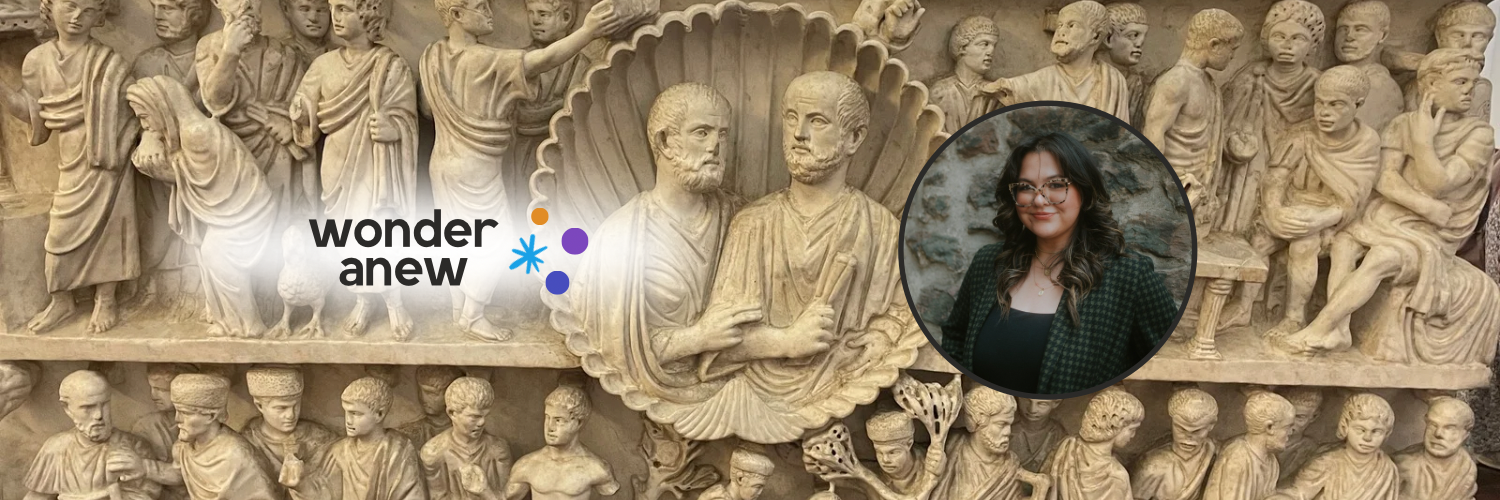
“Sarcophagus of Two Brothers,” found in the Vatican Museum; photograph by Mattie Mae Motl.
Wonder Anew is a new recurring section of the Church Anew blog, intended for spiritually curious readers who want to explore the Christian faith with honesty, depth, and imagination. Read here and on our Substack.
I like to think of myself as a progressive mom. I am someone who takes pride in teaching her daughter empathy, justice, and compassion. I am Fox News’ worst nightmare—indoctrinating my progeny with the radical, liberal agenda that she should love her neighbour. As a crucial part of this agenda, I have always taught my daughter about different relationships, sexualities, families, and gender expressions. In part, this has come natural to us, because my daughter is incredibly blessed to be surrounded by queer friends and family. One summer, when she was three years old, we took her to visit some of that family—my great-uncle and his husband. My daughter just adores them, so it was an incredible visit.
Except for one thing.
She kept going up to my uncle and asking, “Where’s your brother?”
I was mortified. Suddenly, the board books about gay penguins, the rainbow flags at pride parades, and the play-pretend-weddings between her Ruth Bader Ginsberg and Amelia Earhart toys were all discarded with this single question. What kind of nose-ringed mom was I?!
Gratefully, my uncle and his husband were patient with my daughter’s heteronormative assumptions.
As it turns out, my toddler daughter has a lot in common with trained archaeologists and historians. These commonalities become apparent with one quick walk through the Met, the British Museum, or the Vatican. If you’re an avid plaque-reader like me, you will quickly notice the sheer amount of museum labels which read something like:
“Two male companions.”
“A mother and daughter.”
“Intimate love shared between friends.”
“Two brothers.”
All you can do is giggle as you observe the obvious queer love between two figures immortalised in stone, paint, and parchment. The laughter, of course, can only mask the discouraging realisation that queer love has always been around, and it has always been suppressed.
I had this experience just a couple of weeks ago as I visited the Vatican museum. In one of the first rooms, we were shown an exhibit full of early Christian sarcophagi. As a Bible scholar and certified nerd, I was in heaven. As my tour group continued, I froze in front of one exhibit.
“Sarcophagus of Two Brothers”
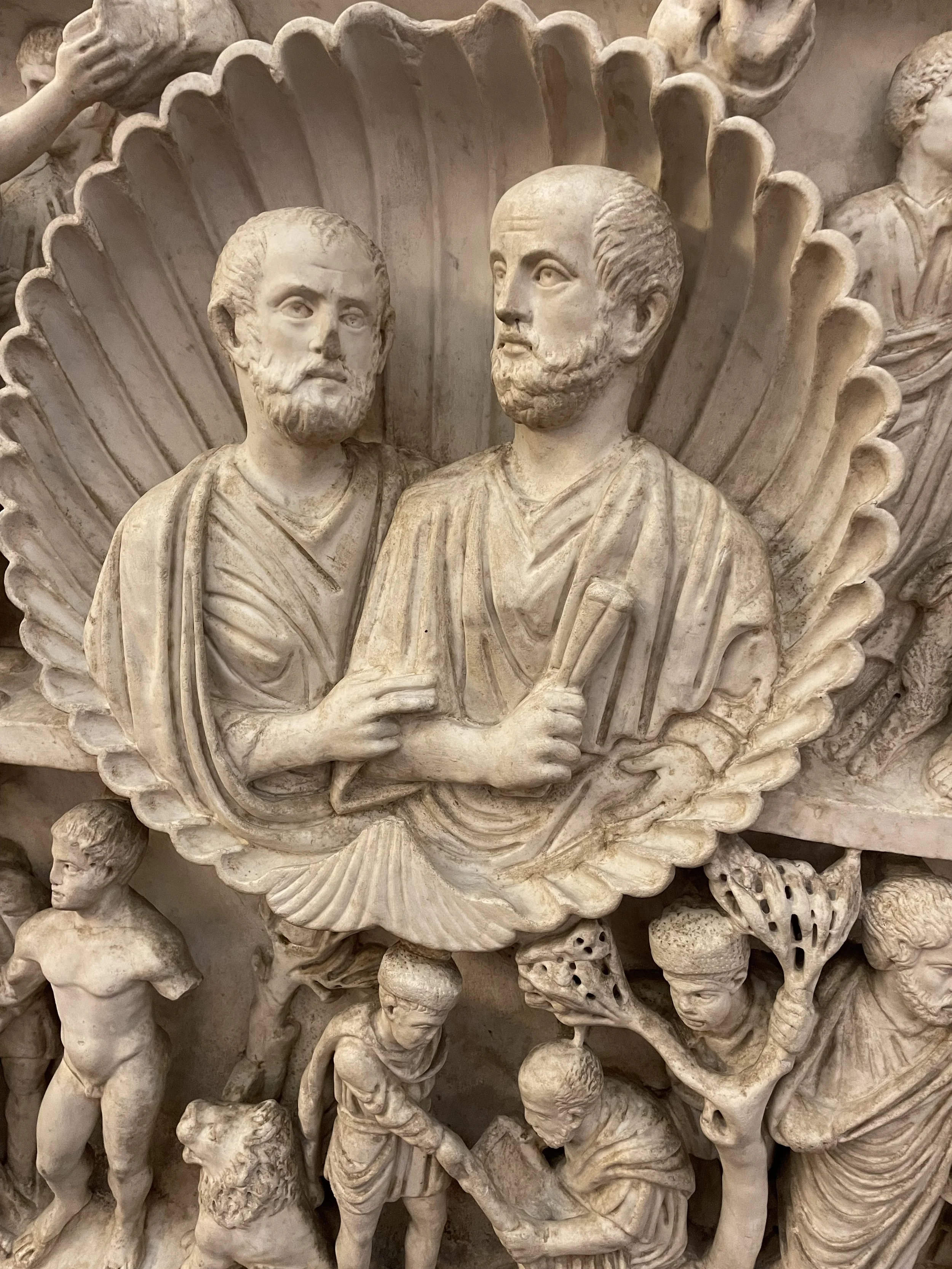
Photo by Mattie Mae Motl
In many ways, this is a typical early Christian sarcophagus. In the middle, we see a depiction of the deceased surrounded by biblical scenes. From left to right in the top row, you can see the resurrection of Lazarus; Peter and Jesus with the cock; Moses receiving the tablets; Abraham with his hand on Isaac; and Jesus before Pontius Pilate. From left to right in the bottom row, you can see Peter and his jailers; Daniel in the lion’s den; Peter with a scroll; Jesus healing a blind boy; and Jesus with the loaves and fish. This tomb gives us incredible insight into the rich interpretive and narrative tradition of the early church (c.325-350).
In their description of the sarcophagus, the Vatican Museum writes:
This monumental sarcophagus (c. 325-350) from the Basilica of St. Paul Outside-the-Walls is notable for its exceptional artistic quality within the panorama of early Christian sculpture. Recent restoration work has revealed that the candid surface of the marble may have been originally embellished with gilding and polychrome finishes. The similarity between the two characters portrayed in the central “clypeus”, or round medallion, arranged like a hinged shell, gives rise to the name of the sarcophagus; in reality, the portraits were originally intended for a couple and only once the work was in process did it become necessary to adapt them to represent the two men, possibly brothers, for whom the tomb was effectively destined.”1
The Vatican Museum is describing the process of carving sarcophagi. In the creation of these magnificent tombs, the artist would leave the faces blank. That way, when they were bought, the necessary adjustments could be made to the couple in the centre. This isn’t unlike the tombstones we buy today—only when they’re purchased are they engraved with the necessary information. Because of this, historians can reasonably assume that this tomb was originally designed for a husband and wife. The biggest clue is the traditional pose of the couple in the center. This pose, the wife on the left with her hand draped over her husband on the right, was extremely common. Here are a few other examples:2
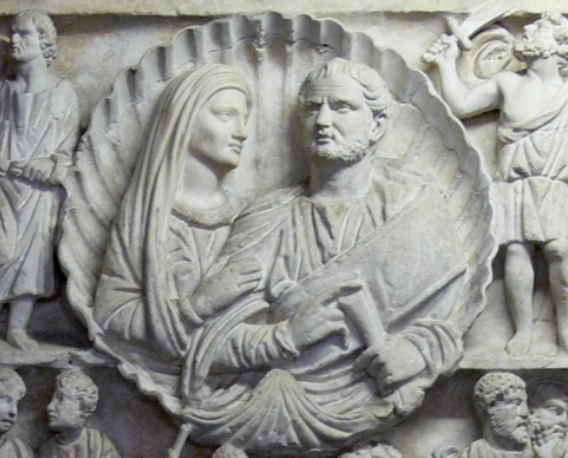
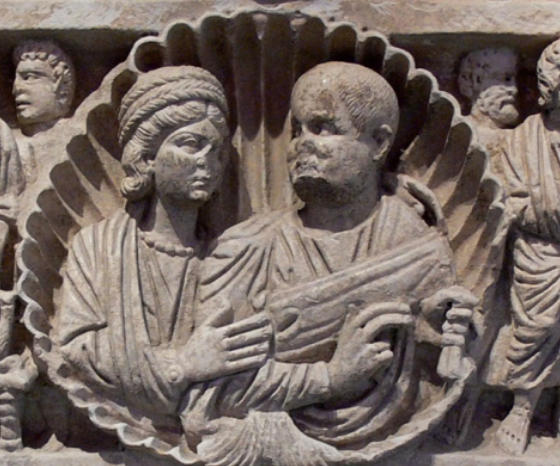
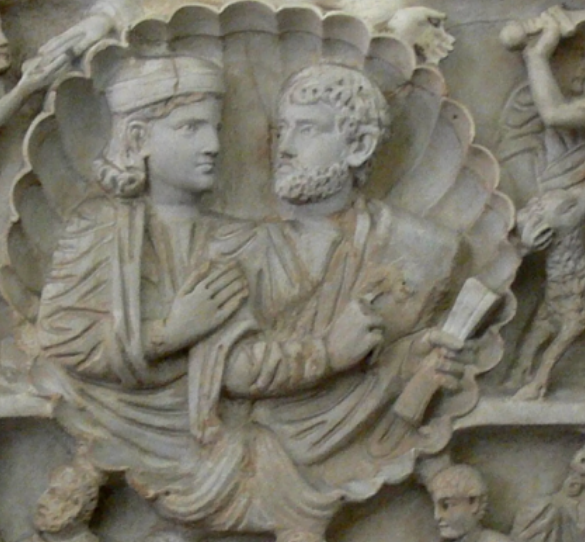
If you look closer at our “two brothers,” you can even see the outline of a breast in the left man’s tunic.
Now, as a proper scholar, I must acknowledge a couple of things. The best we can do is offer conjecture. We will never know, for sure, the nature of the relationship between these two men. However, here’s what we know as a fact:
These two men loved each other enough to go in on a tomb together, and they didn’t seem too bothered by the traditional marital pose or feminine features for the figure on the left.
I want to make one thing clear:
It is just as much conjecture that these two men were brothers as it is that these two men were in love. The Vatican website concludes that these men are “possibly brothers.” It would be just as accurate to replace this phrase with “possibly lovers.” But, of course, there is a whole host of reasons why the Vatican is predisposed to choose one possibility over the other.
Now, the point of this essay is not to persuade you towards one conclusion or the other. However, if we define as “queer” as subverting and challenging the heteronormative standard, this sarcophagus passes that test with flying colours.
The truth is, Christians have been subverting and challenging the heteronormative standard for centuries. In fact, it was the early church’s queerness that caused it to grow and spread so rapidly. The earliest Christians were known for their radical acceptance of people from every status, gender, and culture. They were chastised for the ways they redefined family, defied status markers, and cared for the poor and needy. In fact, one of my favourite quotes from around the same time as this sarcophagus comes from the Emperor of Rome, Julian the Apostate (c.331-363):
“Those damn Christians not only feed their own poor, but they feed ours as well.”
I don’t know the nature of the relationship between these two men. But here’s what I do know—if they loved Christ and loved their neighbour, they were queer. And their queerness is immortalised in stone surrounded by images and stories from the biblical narrative. Because these men were—and still are—a part of that grand narrative. The grand narrative where God chooses the oppressed, prefers the poor, and empowers the queer.
History will say they are brothers.
I will say they are queer saints.
1 https://www.museivaticani.va/content/museivaticani/en/collezioni/musei/museo-pio-cristiano/sarcofagi-_a-doppio-registro/sarcofago-_dei-due-fratelli.html
2 Images taken from the website of Dr. Allie Kateusz, who does valuable work on gender in Early Christianity: https://allykateusz.org/art-as-text-powerpoints/same-sex-marriage-in-early-christian-sarcophagi/