Q&A with Kat Armas on her latest book, Liturgies for Resisting Empire
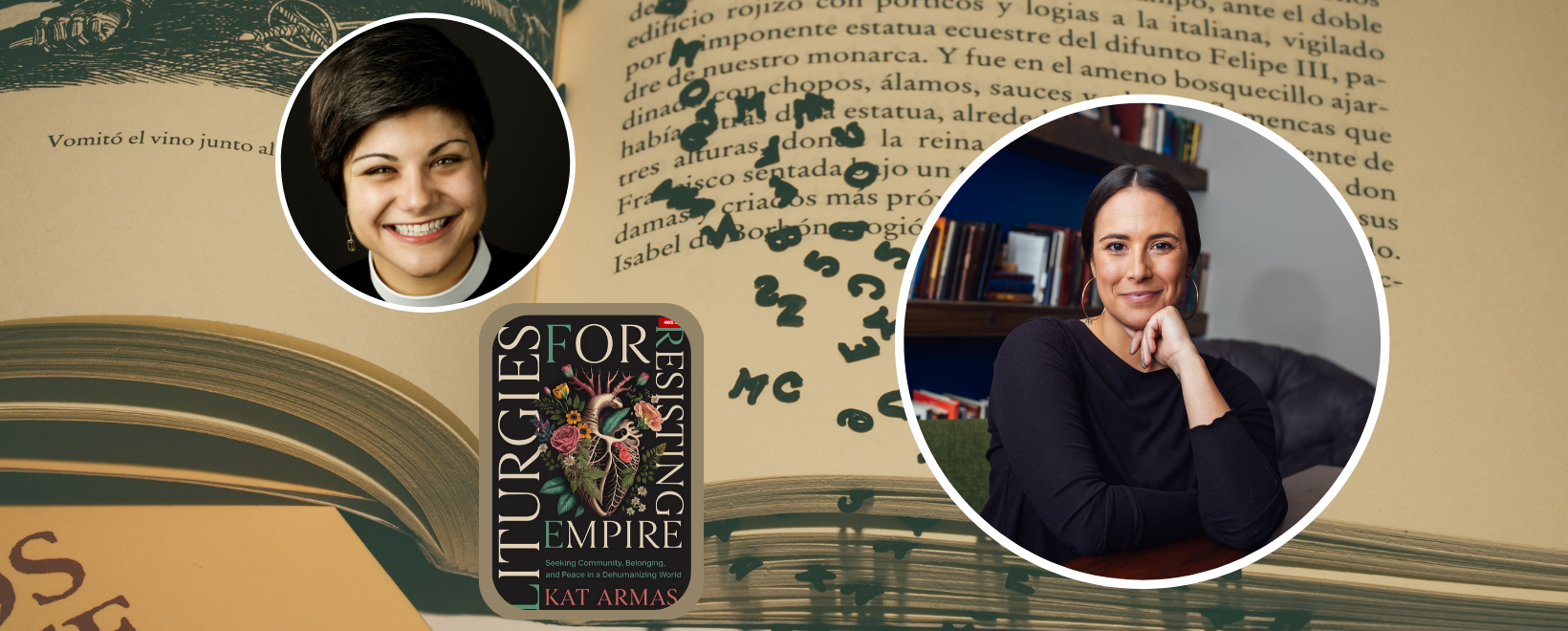
Photo by Hector Reyes on Unsplash
Kat Armas is a Cuban-American author, speaker, podcaster, spouse, mom (to two humans, yes, but also two pigs, three goats, ten chickens, two dogs, and three cats), and always an aspiring abuelita theologian. You may recognize her from the viral article shared by Pope Leo XIV or from her recent contributions to the Church Anew blog. She has previously published two books, Abuelita Faith: What Women on the Margins Teach Us about Wisdom, Persistence, and Strength (2021) and Sacred Belonging: A 40-Day Devotional on the Liberating Heart of Scripture (2023). She sat down with Church Anew blog editor Emmy Kegler to discuss her latest book, Liturgies for Resisting Empire: Seeking Community, Belonging, and Peace in a Dehumanizing World, releasing November 4, 2025.
Why this book, and why now?
People ask me: What are ways we can apply resistance to empire on a practical level? But we are all such vastly different people, with our own traumas and joys and struggles. I can't tell you how to undo hierarchy in your way of thinking and being. I can't tell you how you need to reconnect with the earth; I can tell you go outside, but it's very different for me living on a farm versus someone who lives in an urban setting. I’m always thinking about power and hierarchy in relation to my parenting, but some folks don't have children, some folks have older children. There really isn't one way to say: this is how you decolonize. This is how you rid yourself of empire.
The invitation I’m offering in Liturgies for Resisting Empire is to identify those overarching themes of imperial thinking – like dominance and power, dualistic thinking, structures of hierarchy – that have taken root in all of us, to understand the history and processes of how they came to be, and to make intentional choices that act counter to that and lead us towards communal healing.
You used the word Liturgies, instead of Prayers or Devotions or Meditations, and I think that’s so apt. We get these messages of empire at so many levels. We need form and repetition to root them out – and we need it in community, in “the work of the people.”
I’ve been thinking back to 2020 and this cultural push of Tell me what to do. People just wanted to get it right. Tell me exactly what I need to do, and I will do it, because I want to divest from all that is hurting the world. But with resistance, with removing the entanglements of empire, there is so much internal, personal work. It's a lifelong journey, and it involves coming to terms with your contradictions and also wrestling with the things that make you uncomfortable.
In her book Trick Mirror, Jia Tolentino has an essay that speaks to how she wrestles with her own contradictions of who she is and what she believes. Adrienne Maree Brown talks about this in Emergent Strategy; she says that she loves doing her nails. I love my shellac nail polish. And I hate the fact that people have to be subject to that work that may not want to.
It’s lifelong work to pay attention to how isolation and division and other characteristics of empire keep finding their way back in to how we think and act – how we inhabit our whole being.
When people ask, What is a practical way to apply this?, my answer is: you have to take stock of your life. It's uncomfortable, but it's real, to sit there and say, Yes, I am a walking contradiction. You have to really understand how imperial messaging functions, because you step into a church space and it's exactly replicating the systems that we're trying to divest from. We’re doing the same things in our homes, in our churches, in our parenting, our marriages, how we interact with the land. It’s lifelong work to pay attention to how isolation and division and other characteristics of empire keep finding their way back in to how we think and act – how we inhabit our whole being.
I know so many people who feel absolutely exhausted and disenfranchised, even powerless, against the contemporary forms of “empire.” It’s hard to think about bringing focus inward when there is so much “out there” that demands a response. Give us a vision of the framework for change when we do our own work first.
Adrienne Maree Brown uses fractals in the natural world to talk about how we make change in our societies. I love this idea of fractals, how the patterns in our fingertips mimic the patterns in the cosmos. And these miniature patterns reflect how we are as beings in our homes first, and that pattern reverberates into the whole of creation. Everything we observe in ourselves, we use that to say: I am a microcosm of the system. If I want to see change out there, it has to start here. It has to start in how you raise your children, how you interact with folks on a day to day basis. Are you redoing these structures, the spaces that you inhabit? That's where change needs to start.
Change really requires us investigating the way that these ideologies have manifested and embedded themselves in us. We say we reject the colonizers of the past, but on social media, for example, we’re still bringing in the same dichotomous mindset, the same black-and-white thinking. As a society, as a people, we’re acting as if everything needs to fit into its space, into its square, and if it doesn’t, then it can't exist. Right there, that is the doing of imperial thinking. How are we going to move forward if we're constantly expecting perfection from everybody all the time?
That's what I'm hoping that Liturgies for Resisting Empire does, is call us into that space of unlearning and undoing, a space where we can embrace abundance and nuance – and being people okay with being in process, for ourselves and for each other.
What’re you reflecting on now, now that the book is “done”? What new insights are you finding yourself drawn to?
I keep coming back to this sense of abundance. I was having a conversation with my husband the other day, about we feel there are moments when we have to be present with our kids and we're so tired or so overwhelmed or we're so distracted that we feel like giving more of ourselves is going to take something away. If I give more to my child in this moment, it's going to take away from something else. But that's not the case. It's going to add more. Abundance is not an actual thing of give and take: I'm going to run out of time, I'm going to run out of energy, I'm going to run out of desire, will, whatever it is. No, I possess all of these things and I can give freely.
One of the stories that has really captivated me is that when the Israelites were called out of empire, they roamed the desert for forty years. They had to have all these ideologies about empire removed from them before they were able to enter a space where God says: you're ready. Everything that happened to them was a specific conversation with how empire had formed them and how they could be unformed by these ideologies. You think of manna in the desert -- going back to scarcity and abundance -- it was a reframing of the mind. Empire teaches you to hoard and teaches you to only think about yourself. But this manna is going to teach you that there's always enough and that you don't have to hoard and that there's enough for all of us to share in community. The list goes on and on. The commands that they were given, the way that they were taught to live in community, the ways they were taught to rest on the seventh day. God is saying, I want to rid you of these ideologies that empire teaches. And when you're ready, when we get to a place where I feel like you're ready, then we'll be able to step into a new space.
But it was forty years of ridding empire from the people. We have this vision of wilderness as desert, isolation and hardship. But in a lot of places in Scripture, you see the wilderness as a space of unlearning. We're not gonna get it the first time. We have to be patient in order to come together as a people to do the thing that we're trying to do. We have to be willing to let it take however long it takes. It might take forty years. I think it's going to take the rest of our lives, because we're living under a system that is bogging us down completely in every angle that you can imagine. That's what I'm hoping that Liturgies for Resisting Empire does, is call us into that space of unlearning and undoing, a space where we can embrace abundance and nuance – and being people okay with being in process, for ourselves and for each other.
Liturgies for Resisting Empire releases November 4, 2025. Pre-order your copy from Baker Book House for 40% off, and check for Liturgies for Resisting Empire: The Podcast wherever you get your podcasts!