The Ungovernable Mary Magdalene
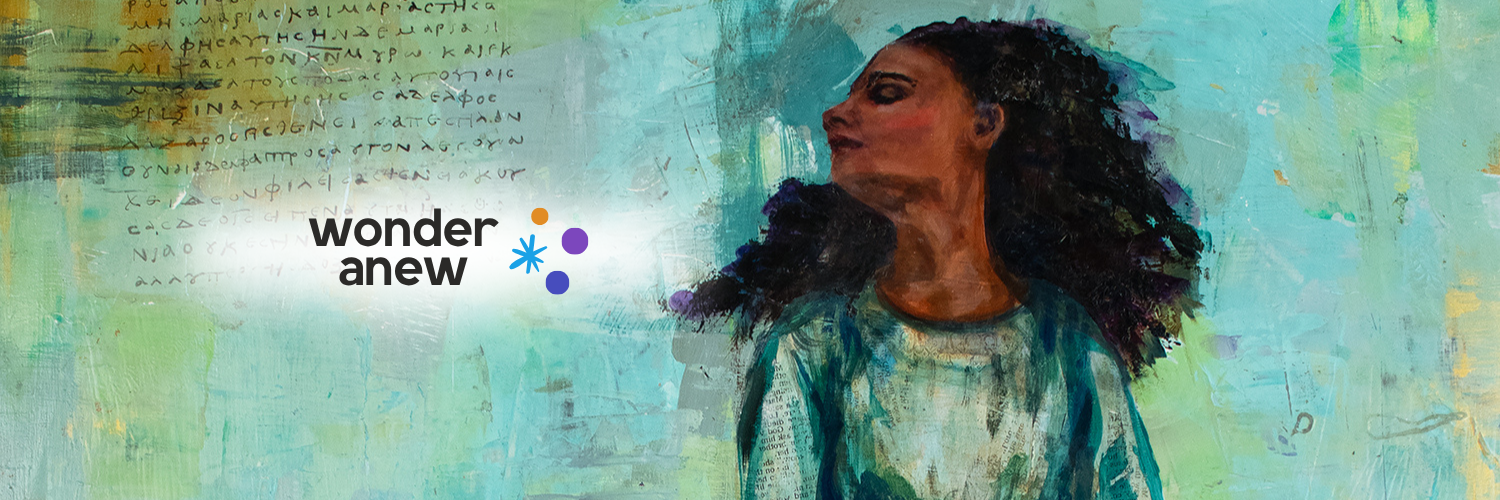
"Mary the Tower" by Casey Wait, inspired by the scholastic work of Elizabeth "Libbie" Schrader Polczer. Note the Koine Greek in the corner! Used with permission.
Wonder Anew is a new recurring section of the Church Anew blog, intended for spiritually curious readers who want to explore the Christian faith with honesty, depth, and imagination.
In the middle of the week in the middle of the hottest month of the year (in Texas, anyways), we celebrate the feast of Mary Magdalene. July 22. On the one hand, it feels like a short shrift to the Apostle to the Apostles. She gets one day? In the middle of Ordinary Time? And that’s … it?
Typical.
On the other hand, though, in the spirit of refusing to let the crumbs be all we think we deserve, I’m choosing to see this as consonant with her unpredictable, heated indomitability. Because Mary Magdalene is not a saint to be trifled with.
You likely have heard that she was a sex worker. This isn’t in the Bible; this comes from an Easter homily given by Pope Gregory in 591, who got Mary Magdalene tangled up with Mary of Bethany and/or the “sinful woman” of Luke 7:36–50. (Isn’t it fascinating how, whenever women are called sinners, it surely must be that this sin is sexual “deviance,” an assumption never made for sinful men? Even now, in a world that knows just a shred of what Epstein did. Fascinating.) His sermon resulted in the still pervasive belief that Mary Magdalene was a repentant sex worker, or at least, a promiscuous woman — and she has been depicted as such, with various flourishes adding that she was fabulously wealthy or intoxicatingly beautiful, throughout Western art history.
All because a woman, Elizabeth Schraeder, like Mary Magdalene herself, demanded to know more.
Now here’s where it gets juicy: Scripture does not call Mary Magdalene a sex worker, and even if it did, it’s clear that Jesus saw the dignity and image of God in the people who do sex work (Matt. 21:31). But Pope Gregory’s mishap is actually more understandable in light of modern scholarship — not for the oh-so-predictable attempt to diminish the power of a woman by claiming her power is sexual and subservient to men’s access — but because it’s likely that Mary of Bethany is Mary Magdalene in the Gospel of John.
Not because Mary of Bethany and Mary Magdalene were actually the same person in real life. Instead, someone edited Mary Magdalene out of John 11 in Papyrus 66, which is the oldest, most complete copy of the Gospel of John that we have. And this discovery is new — so new it is still unfolding in our lifetime — and made by Elizabeth “Libbie” Schraeder. She realized, in examining the newly-digitized images of Papyrus 66, that someone had changed the Greek letters of Mary to Martha, changing an iota to a theta. Since then, as she was recently updating Diana Butler Bass on The Cottage, she has made the case that early Church fathers like Tertullian and John Chrysostom cite Mary as saying things in John that we, in our English Bibles, read as words by Martha. She shows how almost all ancient art depicting Lazarus and Jesus depict only one sister with him — Mary Magdalene, not Mary and Martha.
To be clear: we haven’t lost Mary and Martha of Bethany; they are still in Luke, and still essential disciples and leaders in the ministry of Jesus. But in John’s Gospel, there has emerged a new-to-us but actually-older version of the story. It is Mary Magdalene in John 11 who comes flying down the lane when she sees Jesus coming and screams at him: “If you had been here, my brother would not have died!” It is Mary who makes the first assertion in the Gospel of John that “I believe that you are the Messiah, the Son of God, the one coming into the world” (Jn 11:27b, NRSVUE).
And when we see John’s accounts of Mary Magdalene as a throughline from her bearing witness to Jesus raising her brother Lazarus from the dead, to anointing Jesus’ feet with pure nard, and then staying steadfast at the foot of the cross, and then — come Easter morning — refusing to leave the Garden when the tomb is found empty, demanding, even, of a man she mistakes as the Gardner “Where did you put my Lord?” so that she might go rescue his mutilated corpse — when you see this throughline of this disciple, this leader, Mary Magdalene, we see why she is called Mary the Tower.
Because “Mary Magdalene” is not likely a name for a village. Magdala is a real place in Palestine now, but it wasn’t called that then. It’s far more likely her name was “Mary Migdal,” aka, “Mary the Tower.”
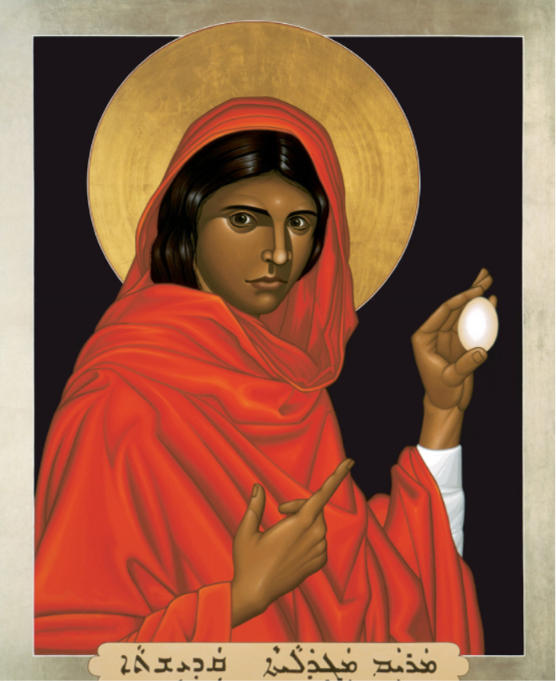
© St. Mary Magdalene, Br. Robert Lentz; Courtesy of Trinity Stores, www.trinitystores.com, (800.699.4482)
And to be clear, this isn’t some fringe scholarship. When Elizabeth Schrader discovered this error, the Harvard Theological Review published her findings. And then, the Nestle-Aland Translation Committee of the Greek New Testament – the guardians of the Greek New Testament – agreed: something has gone amiss with thousands of years of translations. In the forthcoming 29th edition of the Greek New Testament, there will be footnotes explaining that there is a whole other way to read John 11 than what we have heard our whole lives.
All because a woman, Elizabeth Schraeder, like Mary Magdalene herself, demanded to know more.
And we haven’t even gotten to the Easter Eggs.
There are as many stories about easter eggs being connected to Christianity as one can weave, but the one I have heard the most from predominantly Orthodox circles goes like this: Mary Magdalene was furious with the Roman Empire in the wake of Jesus’ death, resurrection, and ascension. And, she was determined to spread the good news of Christ wherever she could.
So she walked to the belly of the beast. She went to Rome, and demanded — and received — an audience with Emperor Caesar Tiberius. She denounced what Pilate had done but told of the miracle of Christ’s resurrection. Caesar didn’t believe her, until she said, “behold this egg,” and the egg, plucked from his own table, turned red in her hands. This is why she is often portrayed holding a red egg in iconography.
The woman who, in all four Gospels, was there at the empty tomb. The women who was unafraid to let Jesus have it in her own grief stayed with him as he died, and was there when he sauntered out of that tomb. And if we believe this legend, her courage didn’t stop there. She went right to the emperor to try and convince him that the real Son of God has risen — despite Caesar’s best efforts to crush him and his people.
May we all have the faith of Mary Magdalene, a tower of ungovernable audacity.