Brunelleschi’s Miracle: How Patronage Makes the Impossible Possible
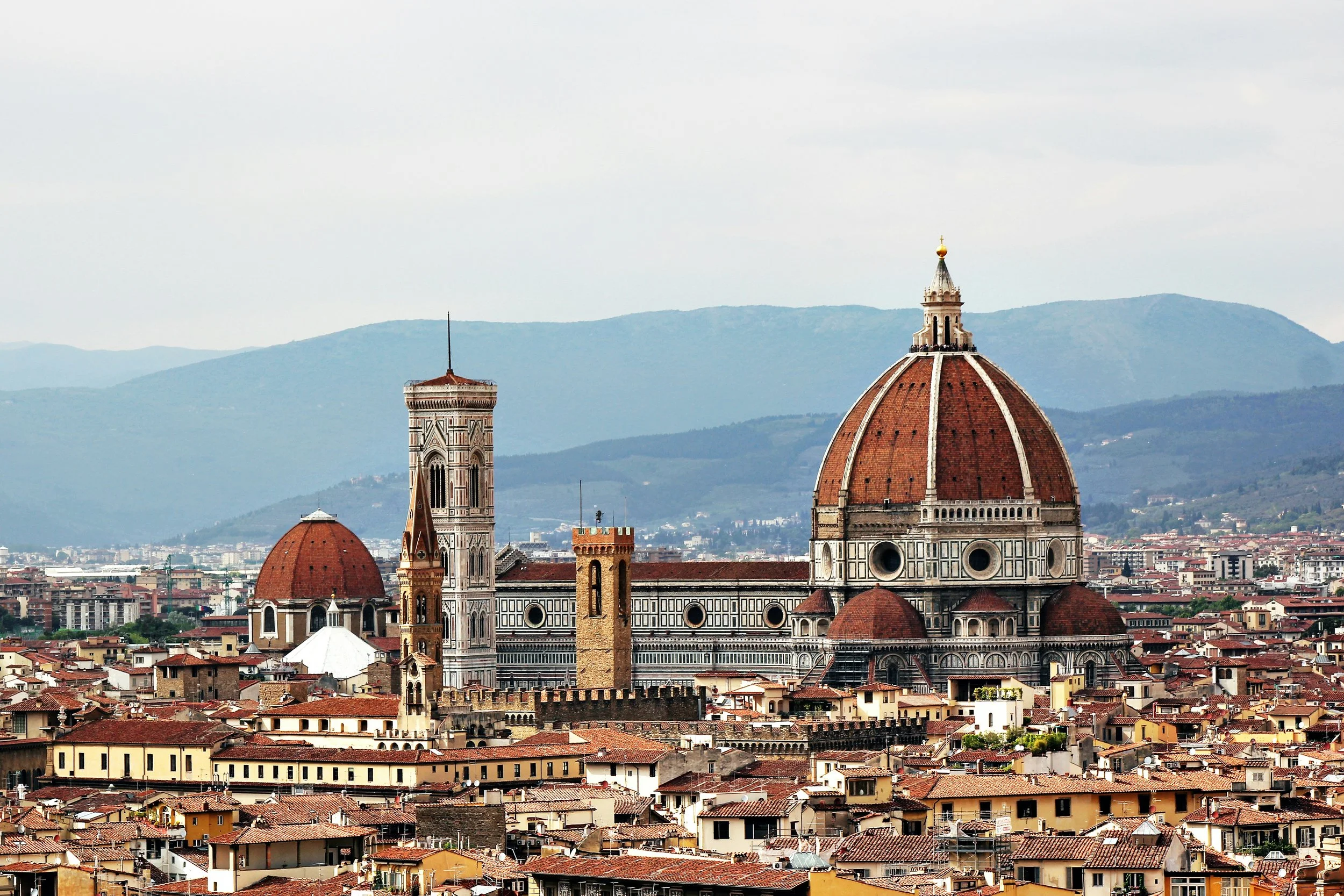
Photo by Jonathan Körner on Unsplash
Florence’s Duomo. The crowning achievement of fifteenth-century architecture, completing the Santa Maria del Fiore (now the Florence Cathedral) in the center of town with a soaring 376-foot height that dwarfs the surrounding buildings. Its completion was a hundred and forty years in the making, and it remains the largest stone-built dome in the world. Four and a half million global travelers visit the Cathedral per year.
The dome (in Italian, Duomo di Firenze) is aesthetically striking without its history, but the backstory only elevates its magnificence. The original architect of the cathedral, Arnolfo di Cambio, had planned in 1296 for an eight-sided dome higher and wider than any other in the world. This was doable -- except it was to be built without traditional Gothic buttresses. Florentine architects avoided their use, considering them makeshift and ugly, and reminiscent of northern European constructions by Italy's frequent enemies and invaders. (This break with Gothic tradition is often cited as one of the first events of the Italian Renaissance.)
A dome without buttresses would have still been doable with the use of temporary wooden scaffolding – yet here again there were insurmountable problems. The cathedral was in use, and an interior wooden frame would disrupt worship for years on end. In addition, the timber available in the Tuscan region was unlikely to support the intended diameter and weight of the dome under construction.
Florence’s dome should not exist, and yet it does. It stands as a testament not only to the nearly limitless possibilities of human ingenuity, but also to the practical necessity of fiscal support to make such artistry possible. While the Duomo could not exist without the genius of its architect Filippo Brunelleschi, it also relies on the historic and present courage of independent donors to support and champion artistic vision and experimentation.
It was Cosimo de’ Medici’s money – not the Church’s! – that would fund the Duomo’s construction.
The culture was rapidly shifting in fifteenth-century Florence, sowing the early seeds of what would turn the city into the birthplace of the Renaissance. In the population crater caused in the 14th century by the Black Death, the worth of a common laborer had significantly increased. The masses had long been treated as a single entity that could be manipulated by feudal lords; now, individuals were gaining their own sense of power. This allowed for career specialization outside of family tradition – you no longer had to be a blacksmith because your father was a blacksmith, but instead could explore apprenticeships within other, potentially more lucrative, trades. The increased value of their labor provided families with previously unaccessed geographical options, and a substantial number of farmers, craftsmen, and other laborers began moving to the cities.
As the cities grew, so did the middle class. Wealth had previously been restricted mostly or exclusively to princes and to the feudal lords who promised them allegiance. With the rise of valued labor and ever-expanding global commerce (in which Italy, with its many ports, became a nexus), it was now possible for the “common man” to become a person of means.
While the southern areas closer to Rome remained within the Catholic Church’s sphere of influence, cities in northern Italy (Venice and Milan, along with Florence) had begun to extricate themselves from the church’s rule. The mountainous regions of the Alps hindered attacks either by Germanic armies to the north or Roman forces to the south. As the northern cities grew in population and fiscal power, they began forming communi, or city-states, which functioned autonomously from the rule of the Roman Catholic Church and its clergy political system. While the church played an inextricable role in everyday faith and life, it did not have total political power, and the city-state was ruled by a representative government.
Into this perfect storm of cultural shifts rose the House of Medici. Cosimo de' Medici had such a capacity to generate wealth for himself and others that he became the functioning leader of the Florentine city-state by 1434, though he avoided actually taking public office. The Medici family would control Florence for the next sixty years, and through their fiscal influence and artistic patronage would turn the city into the birthplace of the Renaissance.
Along with many other projects, Medici would take a vested interest in the completion of Florence’s cathedral. The building itself was begun in 1296 and “finished” in 1380 but without a dome. It was Cosimo de’ Medici’s money – not the Church’s! – that would fund the Duomo’s construction. Medici had previously funded Brunelleschi’s work, notably the Basilica of San Lorenzo (also in Florence). While Brunelleschi had no formal architectural training, he had established himself as more than capable of reimagining antiquity with innovation – a burgeoning hallmark of what would become Renaissance style.
Medici’s nearly unbridled fiscal support allowed for Brunelleschi’s genius to truly shine in the completion of the Duomo. To this day, scholars are not entirely certain of all the methods used to create it. Some aspects are known: the double-layered dome, herringbone pattern, and hidden iron and stone chains spread the weight stress of four million bricks to the eight support columns. But Brunelleschi was notoriously secretive, and no formal blueprints or detailed plans survived the dome’s construction.
Cosimo de’ Medici knew Filippo Brunelleschi was brilliant, but the task which lay before him – the largest self-supporting dome in the world – would have made any cautious investor balk. Yet Medici took the risk. He provided Brunelleschi with the patronage necessary to accomplish the truly incredible. As a direct result of Medici’s investment, Brunelleschi completely transformed the capacities of architecture in his day and set Florence up as the center of the Renaissance, with the Duomo as its indelible symbol. Still today in the Florence Cathedral we can witness how the patronage of bold investors, outside the bounds of the institutional church, has the capacity to liberate artists to transcendent innovation, inspiring generations to come.