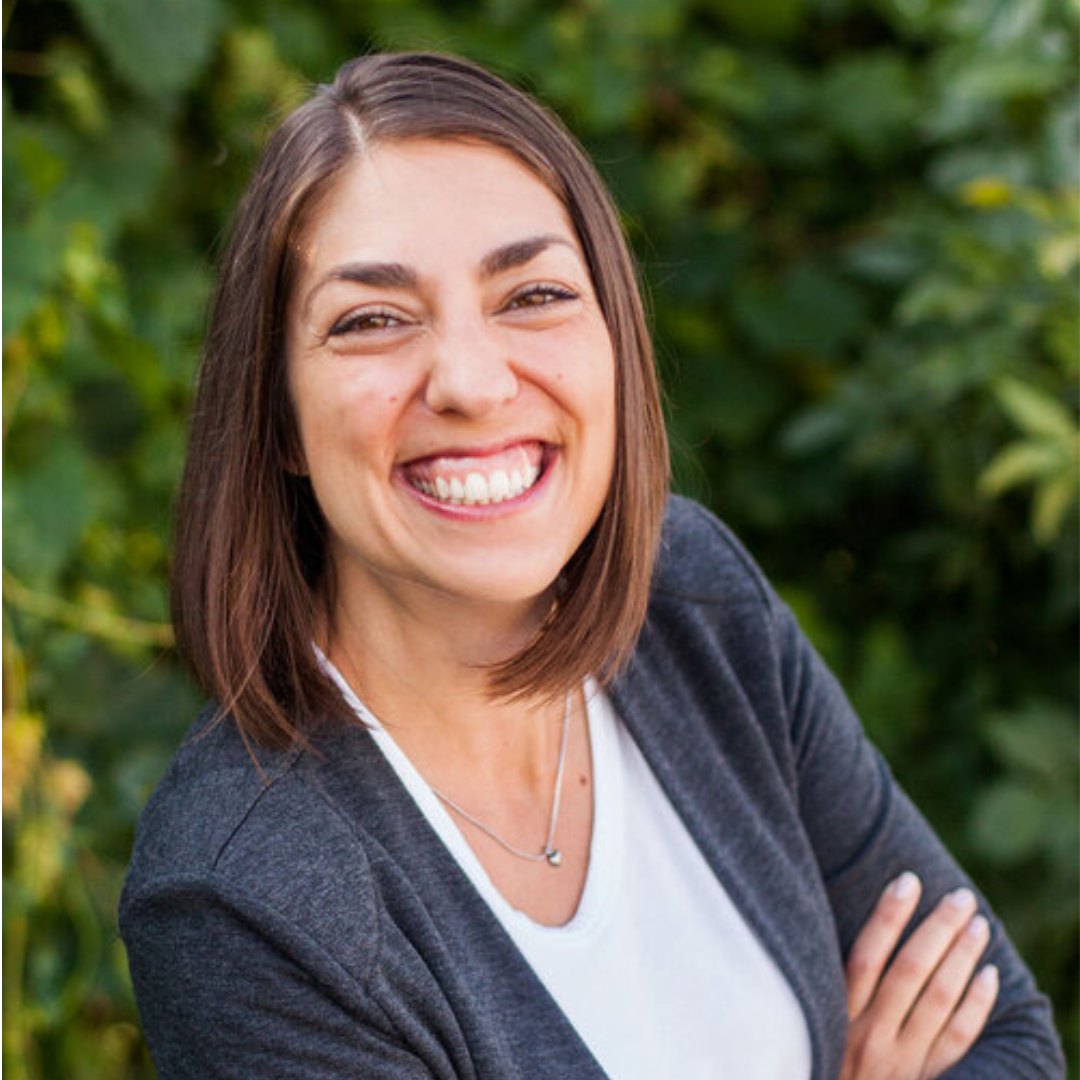
It All Counts: Author Q & A with Rev. Natalia Terfa

Pastor, author, and Church Anew Creative Director Natalia Terfa sat down with blog editor (and Natalia’s podcast co-host) Emmy Kegler to talk about her forthcoming book, It All Counts: Finding God Everywhere They Told You Not to Look. Here’s their conversation:
Emmy: Before you were Church Anew’s newly minted creative director, you served in ministry for almost your entire adult life – first as a youth director for 12 years, and then as a congregational pastor for 10 years, and then as an interim pastor last year. How did It All Counts fit into that trajectory?
Natalia: In 2017, Nora McInerny and I started a podcast called Cafeteria Christian.1 Our listeners are largely people for whom the church was not a place they wanted to be, but they still had some curiosity and interest in God, faith, Jesus, Christianity, just curiosity around spirituality. That podcast community has grown and remained energized – we average between 5,000 and 8,000 listeners a week. That would be a huge congregation if it were considered that. My call is really to people who are out there, curious and questioning and wondering and definitely never setting foot into a building.
I think about all these people floating around in the world who aren't gonna walk into a regular church – for whatever reason. And when I started asking, “What are those reasons?”, there were so many answers that sounded like: “I found this thing that is meaningful, but someone said you can’t do it that way.” And the throughline, in this unique space that formed It All Counts, became me saying: “Why? Why not?”
Emmy: And that is what those people are asking, too. If they’re still spiritually curious, or theologically engaged, or whatever it may be when they’re not formally “in a church,” there’s something that is keeping them coming back, keeping them wondering, “Why can’t it work?”
I don't think it makes God smaller, I think it makes God bigger. We are trying to make God small and manageable, and God is always saying, “I am bigger than this.”
Natalia: My response became: “What happens if we do? Let's just try it, you know?” What if you like this thing? What if you see God this way? What if the trees are your cathedral? Let’s follow that. Let's just see what happens if we expand our view of God a little bit wider than what you've been told. Anytime I've done that with people, it has produced so much beauty and joy and liberation that I just feel like it has to be God. That is where this book came out – what if all of it counts? What if all of the things that make you feel like you can't belong actually aren’t exclusionary?
Emmy: One of the things that struck me in reading It All Counts was both how Lutheran and yet not explicitly or specifically Lutheran it is.
Natalia: The both/and of our theology fits so nicely with being embedded in a place, in a congregation, and being fully outside of a congregation as well. It doesn’t place a value on one or the other. It's not Lutheran or nothing, it's not in the building or nothing. We're not a zero-sum game, this is not a zero-sum theology, and we don’t have a zero-sum God. If you're connecting with God in this way, and you are not causing harm, and you are experiencing love and grace – have at it. I don't think it makes God smaller, I think it makes God bigger. We are trying to make God small and manageable, and God is always saying, “I am bigger than this.”
The both/and of this book, and the both/and of my theology is bigger than Lutheranism, and it's bigger than a congregation. We need people in the digital space doing good ministry. We need local congregations who are really honing in on relationships and being together and being a space where people can belong. We need both. What a congregational pastor, a parish pastor does is so important. And – it can't be the only way we connect to the people in the world, because that is not the only place people are. For us to wonder a little more broadly about how we can interact outside of the parish is interesting to me.
Emmy: When you talk about how it all counts, and you lessen the boundaries of where we expect or require God to be, or how righteousness should be done – are there any hard lines for you? Something where you say, “No, it can’t look like that.”
Natalia: The “it all counts, but it doesn't all count” chapter at the very end was an add-on after I had written most of the book already. I simply could not believe the things people were saying and doing and claiming to be godlike or godly. I realized that I have to say: what things aren't? I'm trying to say it all counts, but you can't hate people. It has to fit with who God is, and anytime you make God small, or cruel, or exclusionary, then you're doing it wrong. And anytime any of your questions or curiosities expand God, and free people and free you, then that is God. When it is harmful, it is not God. There's just not harm in love.
If I’m holding behaviors and curiosities and beliefs up against what God wants, God wants us to have life and have life abundant. When you really hold up Scripture and people, it's pretty easy to make decisions based on victims and not perpetrators. Perpetrators of crimes get grace, but they don't get to be in positions where they can keep hurting people. A boundary might make you mad, but that's not the same thing as causing harm.
Emmy: The draft of this book was finished before the federal occupation of Minneapolis in Operation Metro Surge. You’ve been consistently open and outspoken about your involvement in resistance activities here. Is there something that you observed, absorbed, are translating theologically from that time, that you would add as a chapter or a vignette in It All Counts?
Natalia: I learned a lot of things during the occupation. I learned the value of pastoral presence, of showing up in a collar in places where people didn't expect you to show up. I walked around as a chaplain at Alex Pretti’s memorial site the day he was killed. There was a group of us that went. It was very, very cold still – we were still layered up, we were hovering, but there were crowds of people, and we got stopped so often by people saying, “I'm so glad you're here, thank you for being here.”
It matters to people that the faith community shows up at more than a Sunday morning worship service at their church. The power of that being so visible in Minneapolis was really good for people and spoke well of faith in general, and what we're called to do and who we're called to be in the world.
It All Counts: Finding God Everywhere They Told You Not to Look releases July 21, 2026. Preorder it here.
1 Emmy replied with significant laughter, “Oh, really? Interesting.” Emmy has been a co-host on Cafeteria Christian since 2019.