Strategic Ambiguity: Rendering Unto God and Caesar
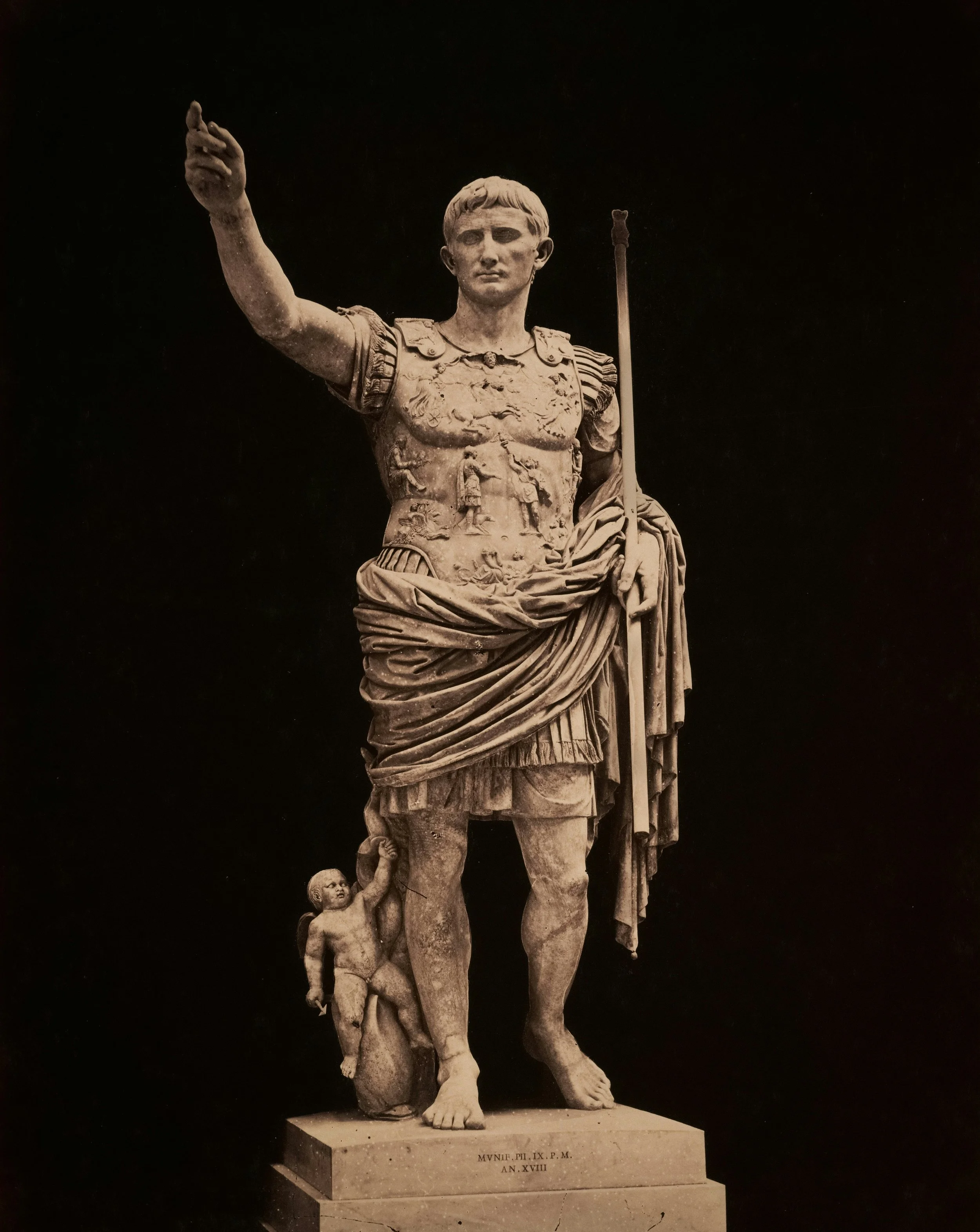
Photo by Boston Public Library on Unsplash
In the spring of 2005, as a first-year M.Div. student at Union Theological Seminary, I remember sitting in the common room of McGiffert Hall, puzzling over a coursebook for my New Testament class with Professor Hal Taussig. The text explored the Roman cult of the emperor, and I found myself straining to comprehend a world in which, amid the transition from republic to empire, a ruler could be apotheosized—believed to have become divine—with corresponding cultic practices and required expressions of loyalty among the people.
At the time, this required a stretch of my imagination. Twenty years later, I’m beginning to understand it all too well.
Over the past few weeks, President Donald Trump—and some of his most ardent defenders—has veered dangerously close to claiming a kind of special divine status. A few days before Easter, Paula White-Cain, an evangelical pastor and one of the president’s chief spiritual advisers, compared him to Jesus Christ: “You were betrayed and arrested and falsely accused. It’s a familiar pattern that our Lord and Savior showed us… and sir, because of his Resurrection, you rose up.” Days later came the president’s own post on Truth Social, depicting himself as Jesus healing a sick man, with worshipers looking on in adoration.1 Both incidents were condemned as blasphemous by many Christians, but the trajectory itself is revealing.
Equally revealing are the accumulating comparisons to Roman emperors, who were considered divine. Just this past week, a massive Roman-style triumphal arch was approved by the Commission of Fine Arts—a structure planned to reach 250 feet, more than twice the height of the Lincoln Memorial, and which, if built, will be the largest in the world. When asked what victory the arch would commemorate, the president’s one-word response was: “Me.”2
Perhaps the most striking comparison (for me, anyway) is a mid-March decision by the same commission to develop a commemorative 24-karat gold coin bearing the president’s image. In doing so, it brushed aside longstanding American resistance to the portrayal of leaders as Kings, figures believed to lead by divine right.3 It also brings us closer to one of the most well-known scenes in the Gospels, when opponents of Jesus produce a coin bearing Caesar’s face and the inscription: Tiberius Caesar, Son of the Divine Augustus.4
In the end, strategic ambiguity may delay the cross, but it does not prevent it.
Taken together, these developments make it difficult—even for a sober-minded observer—to not see this as a form of idolatry at work. It is shocking to watch the President and his most ardent followers repeatedly claim divine status. This is, of course, not new terrain for Christianity. The earliest Christians lived amid many of these same pressures: loyalty tests, cultic expectations, and a widespread pressure to worship an earthly ruler instead of God alone. Amidst what appears to be a bizarre turn to an American version of the cult of the emperor, I contend we have much to learn from early Christian witness as we discern what it means to follow Christ under similar strains.
One early Christian who wrestled deeply with these questions is Tertullian (late second to early third century), an African theologian from Carthage (in present-day Tunisia) and one of the first major Christian writers in Latin. A prolific writer and combative thinker, Tertullian helped shape the warp and woof of Western Christian theology. In his treatise On Idolatry, he describes the delicate balance Christians were forced to maintain while living under the pervasive demands of the imperial cult.
Drawing on Jesus’ enigmatic response about the coin bearing Caesar’s image, Tertullian offers practical—if finely calibrated—guidance. Recognizing that imperial power cares primarily about money (financial tribute), he counsels Christians to distinguish between the claims of money and the claims of God: “Render unto Cæsar the image of Cæsar, which is on the money, and unto God, the image of God, which is in man; so that thou givest unto Cæsar money, unto God thine own self. Otherwise, if all things be Cæsar’s, what will be God’s?”5
The distinction may seem a bit dubious—after all, wasn’t it Jesus who said, “where your treasure is, there your heart is also”?—but I think Tertullian is making a well-intentioned argument. In a balancing act that will feel familiar to many from marginalized communities, he is trying to hold together three concerns at once: helping early Christians remain safe from violence, urging them to participate in the life of the broader society (paying taxes, engaging in civic life and public festivals), all while refusing to render unto Caesar the deeper loyalty and worship that belong to God alone.
Perhaps because of this balancing act, Tertullian is critiqued for being inconsistent or even disingenuous, as his message shifts greatly depending on his audience. When defending Christians against Roman persecution, he emphasized how Christians shared Roman values, portraying Christians as dutiful citizens, even describing them as serving in the military. However, when writing to Christians alone, he frequently stressed the need for separation from Roman society, arguing that Christians should not serve in the army on account of endless war and violence, or as judges due the expectation of sentencing prisoners to capital punishment.6
This seeming inconsistency has been a challenge for those hoping to find an integrated worldview in Tertullian’s work. However, some have pointed out his primary concern was not theological coherence but rather the protection of early Christian communities from Roman persecution. The historian and theologian Geoffrey Dunn noted, “It was not that Tertullian had changed his mind on these questions, but that he presented those arguments likely to be the most persuasive to different audiences. If that meant that in order to save the lives of Christians from provincial persecution he had to hold back his own feelings, then he was prepared to do so.”7
Protection, survival, and perhaps even the hope of outlasting the imperial cult are key motivations, then, in Tertullian’s work. Later in On Idolatry, Tertullian turns to Paul to sharpen the distinction between civic obedience and religious duty, between legitimate political participation and idolatrous compromise: “Wherefore as respects the honour due to kings or emperors, we have the rule sufficiently laid down that we ought to be, according to the precept of the Apostle, subject to magistrates and princes and powers, with all obedience; but this within the bounds of religious duty, and so long as we are separated from idolatry.”8 For Tertullian, Christian life requires participation in broader society, but there is always an asterisk: our faith also requires the fulfillment of religious duty and the careful avoidance of anything the smacks of worship of an idol. In other writings, Tertullian is a bit more clear: if this leads to martyrdom, then so be it. But generally, he seems to hope to keep communities safe from such extremes, urges discernment about which fights are worth it, and instead plants the seeds for what we might term prayerful civil disobedience.
If Tertullian’s advice sounds too conciliatory, it may be because Jesus’ own response in the Gospels is itself strategically elusive. Faced with the coin bearing Caesar’s image, Jesus neither endorses nor outright rejects the imperial system; instead, he speaks a profound truth while sidestepping immediate arrest by his opponents. As I noted in an earlier post, his reply buys him time to continue moving toward the cross on his own terms. “Give to Caesar what is Caesar’s”—pay what is necessary to avoid premature confrontation and capture—“and to God what is God’s”—a claim that insists on honoring God and the image of God in one’s community.
The ambiguity is strategic — but one should be clear that this strategy is successful only to a point. In Luke's Gospel the accusation that Jesus opposes the payment of this tax still appears among the charges brought against him before the Roman authorities (Luke 23:2). In the end, strategic ambiguity may delay the cross, but it does not prevent it.
The Jesus comparisons, the Truth Social imagery, and the Caesar-like symbolism all point toward a troubling trajectory: a national careening toward a distinctly American form of emperor worship, one clothed in the language of white Christian nationalism. With each new post, each new comparison, each grandiose monument, I find myself asking—is this really happening? Unnervingly, yes, it is.
There is, however, a kind of comfort—cold comfort, some might say—in recognizing that we are not the first generation to face this. Indeed, the earliest Christians lived under similar pressures. They lived in a world where political loyalty and religious devotion were blurred, and where refusing to participate carried real consequences. Some chose open resistance and courageously paid with their lives (the martyrs). Others capitulated under duress (the traitors). But for many, the daily reality must have been somewhere in between: a constant negotiation, a careful balancing between separation and participation in broader society, between survival and faithfulness, between an external compliance and an inner refusal to fully obey.
That tension feels uncomfortably familiar. It names the challenge facing mainline Christians today who are watching the rise of something shocking and idolatrous but still must live, work, and worship within the structures of a society shaped by it. What do we owe to Caesar, and what do we owe to God? Jesus’ answer, and Tertullian’s elaboration, invite us to consider a strategic ambiguity toward the state, a position that tries for participation without surrender, engagement without idolatry, whilst offering support for prayerful civil disobedience.
1 The NYT Op-Ed writer David French offers a helpful summary of events here: David French, “I Missed the Part About the Divine Right of Presidents,” The New York Times, April 19, 2026, https://www.nytimes.com/2026/04/19/opinion/trum-christ-pope-image.html
2 Adam Gopnik, “Donald Trump’s Triumphal Arch and the Architecture of Autocracy,” The New Yorker, April 21, 2026, https://www.newyorker.com/culture/dept-of-design/donald-trumps-triumphal-arch-and-the-architecture-of-autocracy
3 Luke Broadwater and Charlie savage, “Trump’s Handpicked Arts Commission Approves Gold Coin With His Face on It,” The New York Times, March 19, 2026, https://www.nytimes.com/2026/03/19/us/politics/trump-gold-coin.html
4 Brettler, Marc; Newsom, Carol; Perkins, Pheme. The New Oxford Annotated Bible with Apocrypha: New Revised Standard Version (p. 1864). Oxford University Press. Kindle Edition. “Roman coins featured the head of the emperor. Title, lit., “inscription,” which read, “Tiberius Caesar, Son of the Divine Augustus, Augustus.”
5 Tertullian, On Idolatry, in Tertullian Collection [2 Books] (Aeterna Press, Kindle edition), 238–40.
6 Esler, P. F. (Ed.). (2017). The early Christian world (p. 962). Taylor and Francis. Kindle Edition. “While he dealt with theological topics, Tertullian was primarily an apologist, polemicist, or even pugilist. He used his rhetoric to win arguments. Although one would hesitate to say that Tertullian lied to win or that he was a relativist, he was capable of downplaying certain inconvenient facts in any particular argument, depending on his opponent and his readers. As a champion of Christianity, he is not alone in having presented his case this way, either in antiquity or more modern times. Thus, Evans has argued persuasively that when he was writing to imperial authorities seeking to persuade them to stop persecuting Christians, Tertullian could offer some positive arguments about the nature and role of the empire and Christian participation within it. For example, against the charges that Christians were cannibals, murderers and atheists, Tertullian could argue that they participated fully in the life of the empire, even being found serving in the military. In works like De corona militis, written for internal consumption only, Tertullian argued that Christians ought not to serve in the army (Dunn 2015), and in pamphlets like De idololatria and De spectaculis he argued that Christians needed to distance themselves from the pagan world around them and stay away from anything, including entertainment, that smacked of the worship of idols. Even though Tertullian wanted the empire to stop persecuting, he encouraged Christians to embrace martyrdom (Ad martyras and De fuga in persecutione) (Moss 2013). It was not that Tertullian had changed his mind on these questions, but that he presented those arguments likely to be the most persuasive to different audiences. If that meant that in order to save the lives of Christians from provincial persecution he had to hold back his own feelings, then he was prepared to do so.”
7 Esler, P. F. (Ed.). (2017). The early Christian world (p. 962). Taylor and Francis. Kindle Edition.
8 Italics mine. Tertullian, On Idolatry, in Tertullian Collection [2 Books] (Aeterna Press, Kindle edition), 238–40.