Render Unto Caesar? A Tax Day Reflection

Photo by Supannee U-prapruit on Unsplash
Today is Tax Day in the United States, an appropriate moment to revisit one of Jesus’ most famous—and often begrudgingly quoted—sayings: “Render unto Caesar the things that are Caesar’s, and unto God the things that are God’s.”
Many people recall the phrase (or at least the first half of it) with a sigh as they prepare their tax returns. Historically, however, the saying has carried far deeper implications than a simple reminder to pay what is owed. It has long served as a focal point for reflecting on the complex relationship between Christianity and the state.
Put plainly, we should recall that the infamous question—“Is it lawful to pay taxes to the emperor, or not?”—was intended as a trap.
The question posed to Jesus—should people pay taxes to Caesar?—and his enigmatic reply, raise profound questions that Christians still wrestle with today. How should Christians relate to civil society? What does it mean to balance religious identity with loyalty to a nation? And when, if ever, should believers practice tax resistance in response to unjust authority?
These questions feel especially pressing this year. As one colleague put it, it is downright depressing to spend one’s days striving to embody Jesus’ love of neighbor, only to “render unto Caesar” a significant chunk of one’s income to a government that has gutted social programs (education, healthcare, global development) while it aims to vastly expand its military budget for unjust military interventions around the world.1 In moments like this, many Christians find themselves asking with renewed urgency: what does it really mean to “render unto Caesar the things that are Caesar’s, and unto God the things that are God’s”?
To begin unpacking these questions, I think it’s helpful to recall three things: the narrative context; the fraught history of the tax being discussed; and what Jesus didn’t say in his enigmatic reply.
The narrative context: Just before this exchange, Jesus dramatically disrupted the economic activity of the Jerusalem temple, protesting at what he saw as its misuse for commerce and profit.2 Entering the temple courts, he drove out those buying and selling, overturned the tables of the money changers, and condemned the temple as “a den of robbers” (Matthew 21:12–13; Mark 11:15–17; Luke 19:45–46). This confrontation sharply escalated tensions with the religious authorities, and the Gospels tell us that the chief priests and scribes then began seeking a way to destroy him (Mark 11:18; Luke 19:47). The questioning of Jesus about his stance on taxes occurs directly after this. According to the Gospel of Luke, spies are sent to entrap Jesus (Luke 20:20). Matthew and Mark describe a surprising coalition of Pharisees and Herodians (Matthew 22:15–16; Mark 12:13). In either case, the questioners’ goal was not an honest theological exploration. Critically, they hoped to ask a question that would result in Jesus being handed over to the Roman authorities for crucifixion. Luke makes this motive explicit: they hoped “to trap him by what he said, so as to hand him over to the jurisdiction and authority of the governor” (Luke 20:20). Put plainly, we should recall that the infamous question—“Is it lawful to pay taxes to the emperor, or not?”—was intended as a trap.
The tax in question: Part of the reason this question carried such weight had to do with the nature of the tax itself. The tax in question was the Roman poll tax, instituted in 6 CE after a census ordered by the Roman governor Quirinius to assess the resources of Judea (Luke 2:2). For many Jews, both the census and this tax came to symbolize the humiliating fact of Roman domination.3
Resentment over this very tax sparked an uprising led by Judas of Galilee around 6 CE (Acts 5:37), often seen as the beginning of what later became known as the Zealot movement. By 66 CE, the Zealots had become a fully established sect within Judaism, known for their willingness to take up arms and engage in violent resistance against the Roman occupiers of Palestine.4 Zealots believed that God alone was the rightful ruler of Israel and that paying taxes to Rome amounted to the idolatrous worship of Caesar.
Those who questioned Jesus may have presumed he sympathized with this kind of resistance. Did he? Although most mainstream scholars do not believe Jesus was a Zealot, it is striking that one of his disciples was known as Simon the Zealot (Luke 6:15; Acts 1:13), and Jesus’ proclamation of the “kingdom of God” was seen as politically subversive under Roman rule.5 During his arrest, Jesus tellingly asks those who come for him, “Am I leading a rebellion, that you have come out with swords and clubs to capture me?” (Matthew 26:55; Mark 14:48; Luke 22:52). In Luke’s Gospel, when Jesus is brought before Pontius Pilate, he is accused of subverting the nation, forbidding the payment of taxes to Caesar, and claiming to be a king (Luke 23:2).
What Jesus doesn’t say: Given the suspicion and stakes involved, Jesus’ enigmatic response is therefore all the more remarkable. Instead of answering directly, he asks to see the coin used to pay the tax. The coin—most likely a denarius—bore the image of the emperor along with the inscription “Tiberius Caesar, Son of the Divine Augustus, Augustus.”6 Holding up the coin, Jesus asks, “Whose image and inscription is this?” “Caesar’s,” they reply. Then comes the famous response: “Give to the emperor the things that are the emperor’s, and to God the things that are God’s” (Matthew 22:21; Mark 12:17; Luke 20:25). The Gospels tell us that those questioning him were amazed by his answer and left him (Matthew 22:22; Mark 12:17; Luke 20:26).
If Jesus had taught unambiguous support for the Roman tax system, a simple and direct reply would have sufficed. He could have simply said “yes” and ended the controversy immediately. The fact that he did not do so is significant and revealing. Instead, his careful reply allows him to avoid being handed over to the authorities at that moment, but the suspicion that he sympathizes with tax resistance ultimately lingers. Indeed, as noted above, in Luke’s Gospel the accusation that he opposes the payment of this tax still appears among the charges brought against him before the Roman authorities (Luke 23:2).
This saying is about taxes and coins, but it is also about so much more.
Over the centuries, given the ambiguity of his reply, both the question and Jesus’ response have been interpreted in a myriad of ways. In most Christian traditions—especially mainstream interpretations from churches historically connected to the state, such as Roman Catholicism, Lutheranism, and Anglicanism—Jesus’ words have been read as urging respect for civil authority. This is usually what people mean when they quote the first part of the phrase, “render unto Caesar,” around tax time.
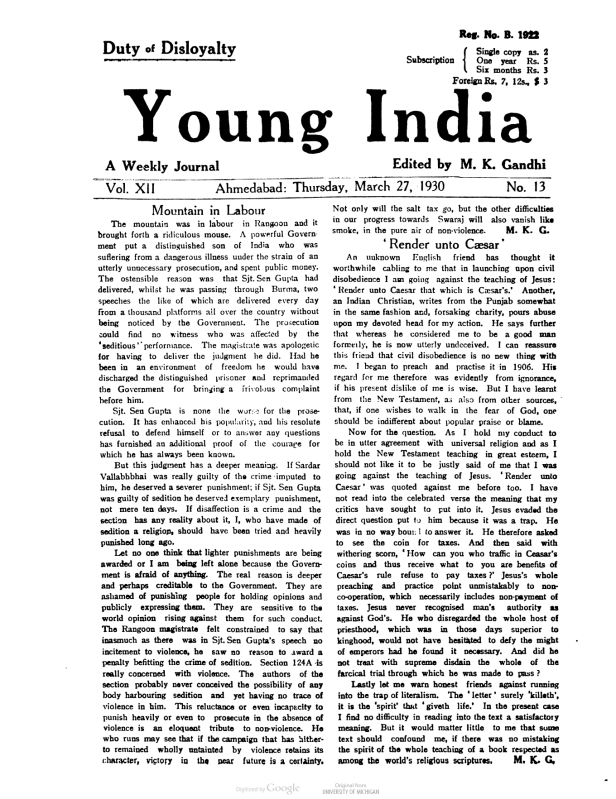
However, others have seen in Jesus’ enigmatic reply a basis for directly challenging the abuses of imperial and militaristic power. Figures such as Mahatma Gandhi and Dorothy Day read the passage as supporting forms of conscientious resistance to unjust systems, including colonial rule and militarism.7 Some Mennonite scholars have likewise drawn on this passage to urge tax resistance to war and militarization.8 In their interpretations, Jesus’ teaching to render unto God requires subverting Caesar’s violent and oppressive aims.
In this sense, Jesus’ reply functions almost like a Rorschach test, revealing as much about the interpreter’s views on power as it does about the precise meaning of Jesus’ words—and that is certainly also true of my own reading of this text.
With Tax Day now upon us, I am conscious of how my interpretation is grounded in my own stance toward the U.S. government: I have a profound appreciation for this country, but I am also deeply disturbed by its global military interventions and its treatment of the most vulnerable, including the immigrants, refugees, and the poor. As someone who works in a context with Latino immigrants, and who regularly accompanies people seeking asylum in immigration court (26 Federal Plaza) where I see ICE agents carrying out their work, what is immediately striking to me about this passage is how Jesus’ reply witnesses to truth while allowing him to live another day. It enables him to avoid immediate arrest and continue his journey toward the cross on his own terms. After all, Jesus’ hour had not yet come. There were still teachings to give and meals to share before his final, sacrificial offering to God.
I therefore read Jesus’ response as highly pragmatic for Christians living under the shadow of a new Rome, an empire in which yet another Caesar is fashioning coins with his face on them: “Give to Caesar what is Caesar’s”—pay your dues in order to avoid direct confrontation with governing authorities—“and to God what is God’s”—so that you may continue serving the divine image reflected in your vulnerable community. Notably, in Luke’s telling, this strategy only works to a certain extent; there is cold realism in the fact that, however thoughtful his response, Jesus is ultimately accused of tax resistance and sedition just the same.
This saying is about taxes and coins, but it is also about so much more. For me, it captures the difficulty, the threading of the needle, of how one lives out divided loyalties: to God and to one’s community, as citizens of an unjust state. On tax day, the question presses upon us more urgently: What do we owe to Caesar? What do we owe to God?
1 The New York Times, “Trump’s Budget Request Cuts Programs That Help Ordinary Americans and Sinks That Money Toward War,” The New York Times, April 7, 2026, https://www.nytimes.com/2026/04/07/us/politics/trump-budget-cuts.html. “At a private lunch last week, Mr. Trump insisted that Washington needed to prioritize “military protection” above all else, especially with the United States still at war with Iran. Otherwise, he said in a since-deleted video, the country could not continue to shoulder the financial burden of services including “day care,” Medicare and Medicaid. Formalizing that view in his 2027 budget, Mr. Trump did not address Medicare and Medicaid directly. But he did ask Congress to slash about $73 billion next fiscal year across a wide array of domestic agencies and programs, including education, health care, housing and nutrition assistance. He coupled that call for cuts with a request to ratchet up military spending by more than $400 billion, which would amount to one of the largest one-year boosts in modern history.”
2 Diarmaid MacCulloch, Christianity: The First Three Thousand Years (New York: Penguin Publishing Group, 2010), 91.
3 Swartley, W. M. (1980). The Christian and the payment of taxes used for war. Peace Mennonite Web Archive. Retrieved September 6, 2024, from https://web.archive.org/web/20060421195552/http://peace.mennolink.org/articles/wartaxes.html
4 See “Zealots” in Browning, W. R. F. (2009). A dictionary of the Bible (Oxford quick reference) (p. 385). OUP Oxford. Kindle edition.
5 Browning, W. R. F. (2009). A dictionary of the Bible (Oxford quick reference) (p. 385). OUP Oxford. Kindle edition.“The identification of Jesus with a popular movement of rebellion has been argued on the ground of his suffering crucifixion, the form of execution for a terrorist or rebel. The theory, however, is unlikely, since Jesus’ teaching about the *kingdom of God was not given in language typical of the later Zealotry (cf. Mark 12: 17). It could be that *Simon, called the Zealot by *Luke but ‘the Cananaean’ by Mark (3: 18) which means in Aramaic a zealot in the sense of an enthusiast, gets this name because of his personal character. Or perhaps he was an enthusiast for God (like Paul, Acts 22: 3).”
6 Brettler, Marc; Newsom, Carol; Perkins, Pheme. The New Oxford Annotated Bible with Apocrypha: New Revised Standard Version (p. 1864). Oxford University Press. Kindle Edition. “Roman coins featured the head of the emperor. Title, lit., “inscription,” which read, “Tiberius Caesar, Son of the Divine Augustus, Augustus.”
7 Gandhi, Mahatma (27 March 1930), "Render Unto Caesar", Young India, archived from the original on 5 January 2016. For Dorothy Day’s tax resistance, see Rice, L. (2024, April). War tax resistance: A Catholic Worker tradition. Catholic Agitator. https://catholicworker.org/war-tax-resistance-a-catholic-worker-tradition/.
8 Swartley, W. M. (1980). The Christian and the payment of taxes used for war. Peace Mennonite Web Archive. Retrieved September 6, 2024, from https://web.archive.org/web/20060421195552/http://peace.mennolink.org/articles/wartaxes.html