War and the Bible: A Mixed Witness
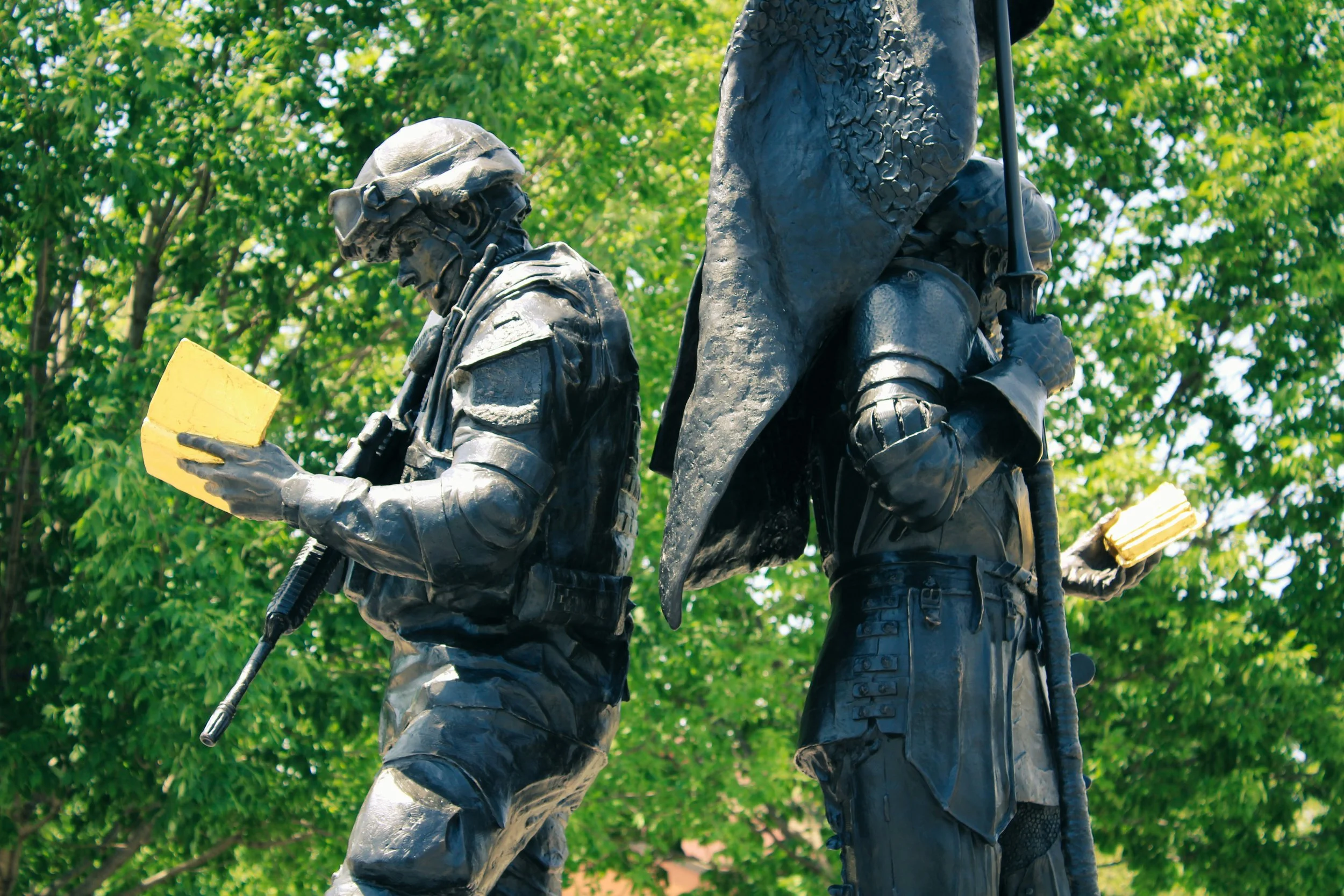
"...they shall beat their swords into plowshares and their spears into pruning hooks; nation shall not lift up sword against nation; neither shall they learn war any more” (Isaiah 2:4 NRSVue)
“Beat your plowshares into swords and your pruning hooks into spears; let the weakling say, ‘I am a warrior’.” (Joel 3:10 NRSVue)
The war between the United States and Iran has activated an old American reflex: when bombs begin to fall, Bibles begin to open, and Scripture is enlisted to justify, protest, or interpret the conflict.
The most recent and controversial examples come from Secretary of War, Pete Hegseth, who quoted from Psalm 144:1-2 at the end of a Pentagon Press Briefing on the Iran War:
Blessed be the Lord, my rock, who trains my hands for war and my fingers for battle. He is my loving God and my fortress, my stronghold and my deliverer, my shield, in whom I take refuge.
He isn’t the first American to claim divine backing for the country’s war efforts, and he won’t be the last.
None of this is surprising. Christian theological language furnishes America’s political vocabulary—and has for centuries. It’s a good reminder, as we celebrate the country’s 250th anniversary, that many of its most precious documents are riddled with theological language. To name just one example, the Declaration of Independence draws on biblical and theological language, appealing to divine providence, humanity’s creation, “Nature’s God,” and the “Supreme Judge of the World.”
Often, conversations about war and the Bible are framed in this way: “What does the Bible say about ‘war’?” Or, “What does the Bible say about our war?” Questions like these seek to place our current circumstances onto the map of Scripture.
Far from being a flaw in Scripture, this plurality is one of its defining features.
But this approach misses the central interpretive and theological conundrum. The real challenge is deciding what to do with a biblical tradition that speaks in multiple voices. The Bible is not a seamless monologue but a diverse library—especially around matters of war and violence.
In the same way that we cannot expect every American to speak with one voice about immigration, capitalism or healthcare, we cannot expect the Bible to speak with one voice about warfare.
Within the Bible’s many pages are texts that sanction military violence, impose limits on its use, and imagine a world beyond it. Given the diversity of social settings—and the more than thousand years over which these texts were composed—this should hardly surprise us. The Bible’s reflections on war are every bit as complicated as our own.
These texts refuse to be tamed. They resist our best efforts to harmonize them into a single, coherent witness on war—or another other topic for that matter. They slip the interpretive leash, insisting instead to speak with distinct and sometimes competing voices. Far from being a flaw in Scripture, this plurality is one of its defining features.
As unsettling as many readers may find it, Pete Hegseth is drawing upon one authentic strand of that witness. The Bible does, at times, portray Yhwh as empowering, commanding, and even participating in military violence. Exodus 15, Israel's victory hymn at the sea, puts it this way: "Yhwh is a warrior" (v. 3). That image reverberates throughout the canon. It is reimagined, repurposed, and transformed in different contexts, but it never disappears. Yhwh is forever a man of war (Rev. 19:11–21).
War and the specter of war were a regular part of life in the ancient Near East, and smaller kingdoms like those of Israel and Judah would have been particularly vulnerable to the effects of war, given their relative weakness in comparison to other, larger nations and empires. Narratives about warfare, victory, and defeat also played a crucial role in the construction of Israel’s national identity (see, Jacob Wright, War, Memory, and National Identity in the Hebrew Bible [Cambridge: Cambridge University Press], 2020).
The challenge is no longer merely interpretive but moral and imaginative. It is not enough to ask what the Bible says. We must do the hard work of discerning together what we will say, with our own voices and in our own time, surrounded by our messy circumstances, and in conversation with all the sources of wisdom available to us.
Paradoxically, the Bible’s plurality of voices is precisely where it is most helpful. Across its pages, the Bible considers war from a remarkable range of perspectives: the dignity of human life, the necessity of restraint, the hope that swords might one day become plowshares, the longing for peace, the burden borne by those who fight, the suffering endured by civilians, the temptation of the powerful to abuse their strength, the cries of the vulnerable, the devastation inflicted upon this world, and the relentless reality of death.
The Bible's gift is not that it settles our arguments about war. Its gift is that it refuses to let us think about war monochromatically. The Bible does not simplify our moral reasoning about war; it complicates it. And that is one of its greatest gifts.